

Book Review
We’re back to “Wintering” and the fact that it’s one of those books that leaves people feeling terribly disappointed – though that isn’t necessarily the book’s fault. In the first part of this post, I talked about how publishers lure readers in with blurbs that are often far more colourful than the actual content. Today, I’ll stop picking on publishers and their marketing departments. Instead, I’m going to pick on us, the readers, and how we contribute to our own disappointment.
What do we actually want from a book that’s supposed to teach us something, show us the way, or – excuse the phrasing, but it’s the only way to put it – “enrich” our lives?
Many people want a recipe and a checklist to tick off with a colourful highlighter, not a story they have to draw their own conclusions from.
Well, we want wisdom and knowledge in an “instant” or “extract” version. Ideally, we want something concrete – quick fixes for our problems, precise answers to frequently asked questions. A checklist where we can mark off our progress with a highlighter to see immediate… well, progress. Maybe a little quiz to diagnose ourselves once and for all – if you get mostly As, you’re an introvert; mostly Bs, an extrovert; and if you’re stuck in the middle, you’re an “extraintrovert.” Then, if you’re an A, you skip to chapter 12, and if you’re a B, to chapter 15, where you’ll find a full breakdown of how to live and handle life’s challenges.
And those kinds of self-help books do exist. They’re incredibly popular because they deliver exactly what many seekers are looking for – a recipe, a list, and a sense of moving from stage to stage. Are they effective? That varies. But they offer a minimum of theory and a maximum of precise advice. In the end, their effectiveness depends on whether we, the readers, actually put in the work. And that’s the key issue – or perhaps the “challenge,” if you prefer. I only truly realised this when I started therapy and it hit me – my psychologist wasn’t going to give me recipes or advice. She was there to provide a safe, professional space for me to “figure out” my own problems. She might nudge me, or summarise something (sometimes so accurately my jaw would drop), but she’d always ask if I saw that as a solution, if I felt comfortable with it, or if the mere thought of it made me uneasy. That was probably the moment I stopped reading traditional self-help. I realised that no text, no list, and no flowchart could solve my problems if I didn’t get knee-deep in them myself and do the heavy lifting. I don’t avoid all self-help books, but I might only pick up three a year now, and I approach them very differently. But back to “Wintering”.
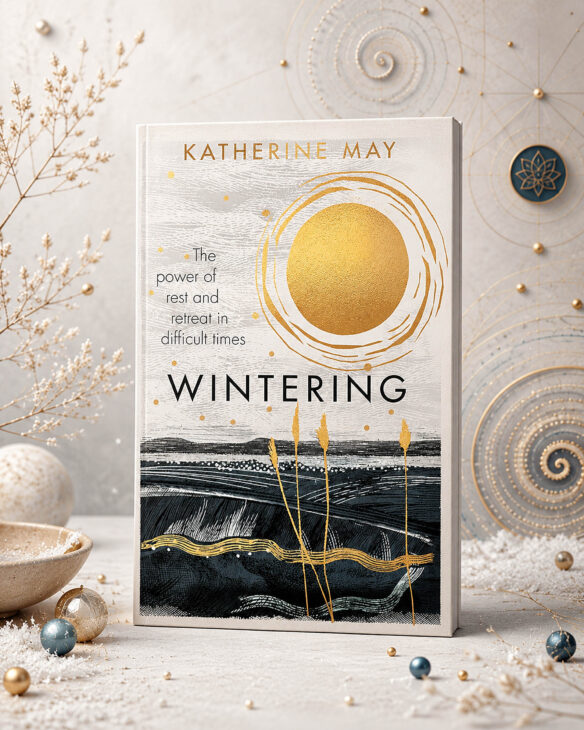
As you know, the author considers Wintering a memoir, but that doesn’t mean it can’t become a guide for us – a starting point for “figuring out” ourselves and our approach to life. But that requires a proactive approach to the text. For me, I read the chapter for the current month and mentally sort the content into three groups. First: “Thankfully, this doesn’t apply to me.” Second: “I have the same problems but a different perspective; let’s see how she handles it, maybe there’s something there for me.” (Or maybe not, as she isn’t the be-all and end-all of psychology.) And the third group: “Good grief, this is me” – word for word, emotion for emotion. There are no tips, no recipes, no lists. It’s just a very personal story from someone brave enough to share it. Finding something in it for myself means thinking, mulling it over, and often re-reading the same two paragraphs six times because something in them won’t let me be. Other times, I’ll breeze through a section because it just doesn’t resonate with my emotional “vibe.”
So, I’m not disappointed in “Wintering”, because I knew perfectly well it wasn’t a manual. Instead, it’s what I’ve long called a “mirror-text.” I could walk past it with barely a glance and see nothing. I could stop for a moment, catch a glimpse of something striking, and move on without much changing. Or, I can treat this mirror as a place to stop for a while. I can look closely at my reflection and notice things that delight me, things that surprise me, and a few things I don’t like at all. But I’m the one who decides how helpful that mirror is. I decide if I have the strength to look into it honestly, without blinking at the difficult parts. And that’s important – sometimes we’re at a point in life where we simply don’t have the energy for “poking around” in our psyche or digging into the past. In those moments, you avoid the mirrors and reach for the blankets and everything that’s warm, cosy, and recharges your batteries.
Two final “fun facts.” Firstly, there’s a theory that winter isn’t the time for grand revolutions. For centuries, our ancestors prepared to simply survive the winter, to rest, and to care for what was closest to them – they essentially shut themselves away and waited for spring. Because spring meant rebirth. “Wintering” echoes this in many ways. Maybe that’s why New Year’s resolutions have felt so wrong to me lately. I know I don’t have the energy for a whirlwind of action and long lists in January. In winter, I lightly hibernate. The days are too short, there’s not enough light, and sleep wins every time. In spring, I can do anything. That’s why I’ve moved my “revolution planning” to around my (thankfully) springtime birthday.
And the second fact: anything that strikes a chord in your soul can become a “mirror-text,” a “mirror-novel,” or even a “mirror-movie.” In my case, if I had to point to the most significant “mirror” in my life, it wouldn’t be an ambitious novel or a weighty self-help book by a big name. The mirror that worked most powerfully for me and changed my life was the movie… “Legally Blonde”. But that’s a story for another time.
Aga J. Mackiewicz
for Intensive Chapters
A human, not artificial intelligence, is always responsible for the substantive content and final form of all texts on this website. No text is the result of any advertising partnership. All content represents our own, sometimes subjective, opinions, and no payment has ever influenced them. Photos used in the posts are our own, while graphics are created with the help of AI tools.