


Book Review
Let me start by saying that, in my highly subjective opinion, “Theo of Golden” gets a solid 9 out of 10 stars. I’ve even recommended it to my own husband in good faith, writing it down on a little note and dropping it into his reading box. One day he’ll pick it out, and I hope he’ll bask in the sheer warmth of this title.
Am I unconditionally thrilled? No. But with “Theo of Golden”, I used a tried-and-tested strategy – zero expectations. Given the absolute explosion of hype surrounding this novel, you could easily think we were dealing with the masterpiece of the century – a brilliant book for everyone, and if you don’t see it, you’re just “not mature enough”. But where exactly were these fireworks of adoration shooting into the literary sky? On social media and the accounts of the publishing houses that invested heavily in “Theo of Golden”. Yet, if you dug a bit deeper, you started to spot the critics’ reviews. There were no fireworks there – just a breakdown of the text’s many pros and equally many cons. I wanted to judge it for myself, blocking out that ocean of praise and not expecting a miracle of miracles. What came out of my assessment? More on that in a moment, but first, a quick plot summary.
Opinions about “Theo of Golden” are completely polarised. They range from pure rapture and calling it the book of the year, to dismissive summaries pointing out that while the novel has shifted a million copies, it doesn’t feature a single flesh-and-blood character. A triumph for the PR department, but a failure for the author? Not quite.
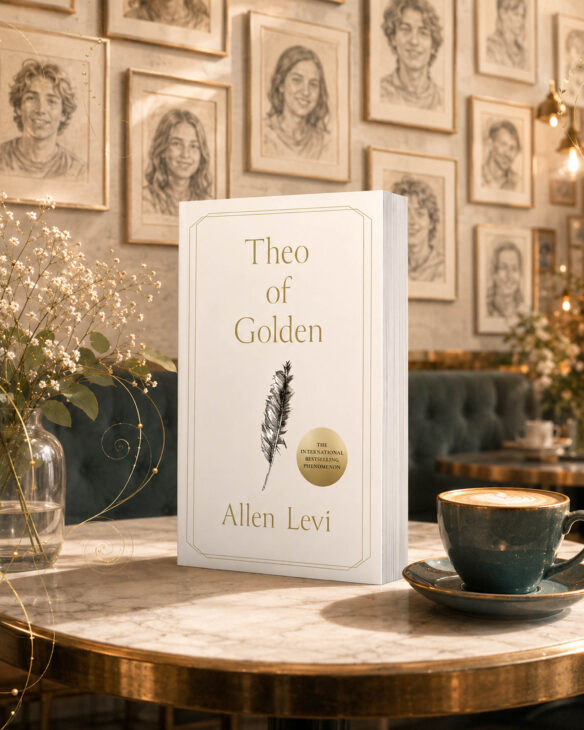
Theo appears in the town of Golden out of nowhere. No one knows why he chose that specific place, no one knows who he is, and no one even knows his surname. What we do know is that he is a distinguished older gentleman, potentially quite wealthy, and clearly keen on keeping his secrets to himself. Ask him anything about his life, and within thirty seconds you’ll get a tiny scrap of information followed by an immediate counter-question, redirecting the attention back to you. Theo remains an enigma. In the local café, our protagonist first lays eyes on a gallery of portraits created by a local artist. He finds it hard to grasp that the subjects themselves, or their loved ones, haven’t bought these paintings to enjoy them in the comfort of their own homes. He decides to right this wrong and buys the portraits, gifting them to the people depicted. These encounters, as the portraits change hands, become opportunities for conversation, forging friendships, getting to know the locals and their stories, and figuring out how to help them – because Theo turns out to be a philanthropist. Will we find out who Theo is? Yes. Will it be explained why he chose Golden of all places? Also yes. But you know perfectly well I’m not going to spoil that for you.
To fully understand the phenomenon of “Theo of Golden”, you need to take a few steps back to 2023. Judging by his interviews, Allen Levi wrote exactly the novel he wanted to write, without any arrogant belief that he had created a global bestseller. In fact, he hadn’t even planned on publishing it. But those around him talked him out of leaving it in a drawer, convincing him it deserved to reach readers. How was it first published? As a niche self-published book. Initially, it circulated within a specific bubble of Christian fiction and “clean read”*** communities. Shortly after, it popped up as a pick in a few celebrity book clubs – though not the A-list ones just yet. Even so, people started talking. That famous algorithm took note. The title grew more and more popular – not quite viral yet, but getting close. And that’s when the big publishing houses noticed Levi’s novel, and the whole machinery roared into life.
“Theo of Golden” turned out to be the perfect marketing material. The memorable cover and the actual setting of the novel – a small town, a cosy café, a wall lined with gorgeous portraits – handed content creators the ideal material for a stunning 15-second clip. Add to that some highly emotional taglines: “This book will break your heart and piece it back together” or “The most beautiful thing you will ever read.” On top of that, “readers” online were putting on extremely emotional displays – crying on camera, throwing the book across the room, gasping in disbelief, and a few other tried-and-tested Instagram and TikTok influencer tropes. That is how you manufacture success.
But the more the novel was talked about, the wider its audience became. The bubble of readers simply looking for a warm, straightforward, uplifting story burst. The publishers weren’t highlighting its simplicity, they were hyping it up as a phenomenon. And that’s where the first disappointments kicked in. The first wave of mainstream readers admitted they had been lured in by the blurbs regurgitated by the publisher, but they were actually looking for psychological realism and masterclass writing (as that’s what was being promised between the lines), and they left feeling let down. Not because it’s a bad story. But because the media and the publisher had promised more, or something different… And so, we find ourselves back at that familiar mechanism – managed expectations falling flat, built not even on what is being said, but rather on what is being left out.
“Theo of Golden” transformed from a quiet, intimate, and very uniquely pitched parable into a “cultural phenomenon”, and the debates only grew more fierce.
Time for my own verdict, but allow me to base it on the most controversial points raised by both critics and fans alike.

Language and style – rambling and pointlessly flowery, or soothing and poetic? For me, the prose was actually a massive plus. I was captivated by the elegant, unhurried storytelling, packed with descriptions of trees, birds, sounds, and colours. And yes, it didn’t exactly accelerate the plot, but it provided a breather, it acted as an antidote to the frantic pace of modern life. Besides, I instantly made the connection that since the protagonist is a sprightly, brisk, yet ultimately elderly gentleman, the narrative voice has to match his pace and his walk through life. Calmness is precious, and this novel delivers that calm. There’s no high stakes or grand tension here, there’s a certain repetition to it – we buy a portrait, hand it over to the subject, and form a connection. For some, this is a flaw – too slow, too repetitive – but for others, it’s a huge selling point. This is a “comfort read”. Its goal isn’t to leave you breathless from a breakneck plot. It’s meant to give you a sense of security, to offer hope in goodness, and to let you watch from the sidelines as the townsfolk slowly transform, witnessing their unique kind of therapy and its results. For me? A definite pro.
Sugar-coated sentimentalism or an ode to radical kindness? Critics say the text practically drips with extreme naivety, the psychological plausibility is close to zero, and it reeks of moralising by the end. “Theo of Golden” isn’t a psychological novel, nor is it a slice-of-life drama, it is – and here we go again – a “comfort read”. The author didn’t write it to deliver profound emotional portraits of his characters, with all due respect to those who do. He wrote it to bring hope to a cynical and difficult world. Selflessness, forgiveness, kindness, love, the desire to do right by your neighbour – that’s what the author wanted to celebrate. And he succeeded. Is it realistic in today’s world? Unfortunately not – and I emphasise the word “unfortunately”. Is it sentimental? Yes, because that’s exactly what we long for. I want to go to Golden! I want my own Theo, someone who will not just notice me, but truly see me, right to my core.
And what about the religious themes? They’re there, but then again, they make perfect sense to me, and in a way that feels highly plausible. Theo is at an age where he knows his life might stretch on a bit longer, but then again, it might not. His reflections on eternity, heaven, and forgiveness stem from his age, his experiences, and the awareness that parting with the mortal world isn’t some distant prospect. Such thoughts are completely normal. If the critics aren’t at that stage of life themselves, making it seem implausible to them, they should go and talk to some elderly people. They might be surprised by how often the topic of death and what comes next crosses their minds.
“Flawless ideals don’t exist,” say the critics. To which fans reply – “don’t we actually need role models to look up to?”. We’re back to that total lack of realism – I saw one comment claiming there isn’t a single living, flesh-and-blood character in the entire novel, just a bunch of “figures”, ideals, and unrealistic behaviours. Apparently, people like that don’t exist. More’s the pity… First of all, Theo is no saint, nor has he had a perfect life. He’s made mistakes, paid his dues, and suffered his fair share. And his current behaviour? His character is meant to inspire, to show that it is possible to treat others with empathy, mindfulness, and unconditional respect.
I’m going to say something that might grate on some people, but I’ll say it anyway – if Theo irritates you, then, as always in these situations, you need to ask yourself what it is about him that rubs you up the wrong way. Dig a little deeper into why that is. Maybe we just secretly yearn for something ourselves, maybe we want something, or want to be a certain way, but we aren’t, we don’t have it, we don’t experience it – so we mask our needs and desires with cynicism or microaggressions.
And while we’re at it, there’s one more thing – the accusation that Theo solves everyone else’s problems with his wallet just because he’s rich. I disagree. Absolutely, totally, and to the very marrow of my bones, I disagree. Even when he does foot the bill for something, it’s never about boosting the recipient’s bank balance. More often than not, he’s giving them a fishing rod rather than a fish, tossing ideas their way, or gifting them something that will make their passion, their work, or their life more beautiful and richer on a non-material level. And besides, Theo always, always – and I mean always – gives his time and attention above all else! He is physically there. Him, not his wallet or his bank account. He is right by their side… *****
For me, “Theo of Golden” wasn’t a novel, and certainly not a psychological drama. It was a parable. It didn’t showcase deep psychological transformations, it showed that change is possible, that kindness conquers all, and that respect is due to everyone, without exception.
Did anything disappoint me? One thing, terribly and awfully – I wanted that fairytale happy ending! When I closed the final page, I felt like it could have happened, that it would have all tied up nicely… But I understood why the author chose the ending he did, even though I’m not exactly thrilled about it.
And yes, I can see the author’s shortcomings in terms of craft. I see that sometimes a description was only there to show that the world is beautiful, which slowed down the already leisurely plot. However, I appreciate that someone actually wanted to describe this beautiful world to me. Yes, it didn’t escape me that there are moments straight from the church pulpit, but they didn’t irritate me, they even seemed quite fitting. Could certain moral and ethical issues have been handled more subtly? Of course, but did they need to be? No, because sometimes you don’t need to pull your punches if you want the message to hit home. And yes, I had a slight feeling that the pace and writing style shifted towards the end. However, I don’t know if it was a bit of a struggle to wrap up the story, or a very deliberate move. I do notice the differences between the first part of the book and the ending, but I see it as a fact rather than a flaw… Aside from that missing happy ending, obviously… But you already know about that.
I’m just happy that Theo and the town of Golden crossed my reading path this year. This story truly touched me, it cured me, at least for a moment, of life’s cynicism and reminded me of a vital life lesson – that the greatest gift you can give people is to be actively and empathetically present in their lives, to look at them and truly see them, to listen and actually hear them, to respect them as individuals and grant them the right to be themselves, completely without judgment.
Thank you, Allen Levi!
*** If you fancy reading a bit more about what a “clean read” actually is and exploring examples from this genre, it’s well worth checking out the review of “Noel Street” by Richard Paul Evans.
***** I promise myself that I will write one more piece inspired by this novel, and by the character of Theo in particular. A text about philanthropy, and about the fact that you can be generous in so many different ways – but the hardest way is when the world doesn’t fawn over your goodness, because there are no camera flashes or applause from an adoring crowd.
Aga J. Mackiewicz
for Intensive Chapters
A human, not artificial intelligence, is always responsible for the substantive content and final form of all texts on this website. No text is the result of any advertising partnership. All content represents our own, sometimes subjective, opinions, and no payment has ever influenced them. Photos used in the posts are our own, while graphics are created with the help of AI tools.