


Book Review
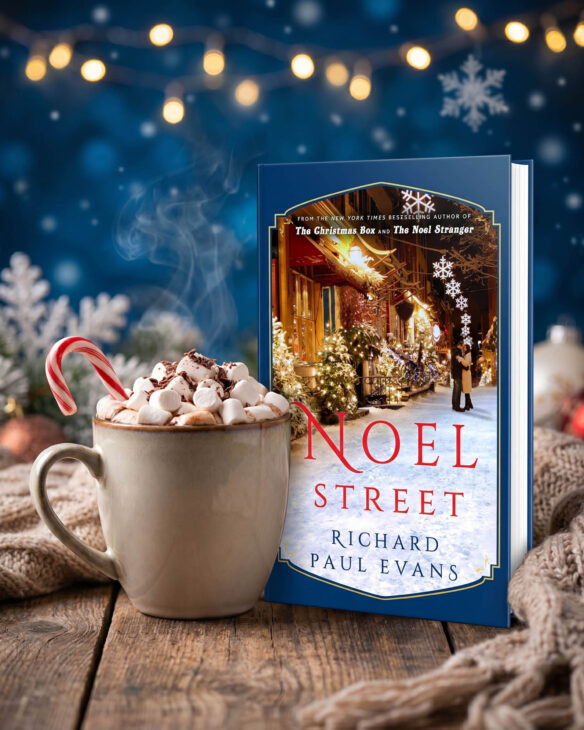
In a small town in Utah, where winter is ruled by frost and snow, and people stay only because they have no other prospects, lives Elle. The year is 1975, Thanksgiving and Christmas are just around the corner, and Elle doesn’t even have enough in her budget for a Christmas tree. She knows this will hurt Dylan the most – the young son she is raising alone, trying to provide him with a normal life in a town where he simply doesn’t fit in. You see, Elle’s son is Black; or to put it more bluntly, he is the only Black person in the entire town of Mistletoe. Elle is the widow of a soldier killed in Vietnam. Her parents accepted neither her love for her husband nor a grandson of the “wrong” skin colour, so Elle left and, with great grace, is trying to be the best mom in the world. And then William appears in this small town – a veteran returned from the Vietnam War, still haunted by his demons.
As it turns out, we aren’t just dealing with a cozy small-town Christmas romance. Or rather, not only a romance, as this novel tackles very difficult issues: racism, PTSD, the pain of losing loved ones, and suffering, but also unquenchable hope and forgiveness. So, while there’s the scent of gingerbread and ornaments on the tree, there is also a dark portrait of a conservative society, social divisions, and the hypocrisy of 1970s America. What makes this portrait even more staggering is that it’s painted not from the perspective of grand politics, but through the everyday life of a small community.

The author of “Noel Street” is Richard Paul Evans, an American writer known for making a Christian value system central to his novels, yet he does so without being pushy; he doesn’t try to convert anyone or put on a preacher’s robes. Evans himself is a Mormon, and faith plays a vital role in his life. He builds his stories on so-called “traditional values” – forgiveness, redemption, the power of prayer, family, and hope – all of which you’ll find here. I’m personally quite sensitive to “evangelizing” undertones in fiction, and they can irritate me immensely, so if I say nothing in this text bothered me, it means the author didn’t confuse his genres. He wrote a contemporary novel with a romantic subplot, not a parable aimed at converting the masses. I think the best summary is that it’s not about dogmas or spreading faith, but about spirituality. This means even a non-believer won’t feel uncomfortable reading it.
It’s often said that Evans and similar writers create “inspirational fiction” – books meant to provide rest and relaxation, or even entertainment, but also to lift the spirit and provoke reflection. I really like the “definition” which says that after finishing such a novel, the reader should feel more hope than when they opened the first page. Furthermore, these stories often lean into “healing literature,” allowing us to process difficult topics using the characters as a shield – we analyse their emotions and behaviours so we don’t have to say “I,” which is easier for many people. To this, I’d add the term “clean read” – novels where the romantic element isn’t over-the-top; it exists, but in a way that you can safely give the book to anyone, even young teenagers. There’s no harsh profanity or graphic violence.
In the U.S., Evans is called the “King of Christmas fiction,” but for him, the holiday season isn’t just a pretty, glowing backdrop – it’s a time of spiritual rebirth and gifts that go beyond the material. You’ll find all of that in “Noel Street”, and then some.
The book is relatively short, and Evans uses a very simple, almost raw language, where dialogues dominate over descriptions. Usually, I’d consider that a flaw, but not here – this style perfectly suits the difficult emotions involved. It leaves everything “raw” and allows the feelings to resonate without being over-explained. They simply exist in the words and actions of the characters.
It struck me that this is a great companion piece to Kristin Hannah’s The Women. However, here the Vietnam War is shown through the lens of a tiny town and how it affected the daily lives of people who never protested, never saw the mass arrival of coffins from military planes—the war simply entered their homes quietly.
If you feel that Richard Paul Evans and his literature, rooted in a Christian value system, might be for you, here are a few more names to check out:
- Karen Kingsbury – lots of emotion and faith; often called the “Queen of Christian Fiction.”
- Nicholas Sparks – frequently weaves a Christian approach to faith, love, and destiny into his stories.
- Francine Rivers – offers a slightly deeper theological approach, often rewriting biblical parables in different settings.
And if you want to know more about healing literature or read my review of “The Women”, there are links below:
Aga J. Mackiewicz
for Intensive Chapters
A human, not artificial intelligence, is always responsible for the substantive content and final form of all texts on this website. No text is the result of any advertising partnership. All content represents our own, sometimes subjective, opinions, and no payment has ever influenced them. Photos used in the posts are our own, while graphics are created with the help of AI tools.