

Book Review
Let me start with a very personal memory. I first picked up “Il Rimorso” (“Remorse”) over thirty years ago. I was in my teens, and I can still recall the emotions it stirred in me. They were intense – at times, some parts were hard to understand for a young girl reading about the choices of mature, married women – but I was left with the conviction that this is a novel one cannot remain indifferent to. It strikes chords deep within the female soul. I have just finished reading that very same copy, now with half a century of life behind me, a sea of experiences, and a long marriage to my name. This time, the raw emotions weren’t there. Instead, there was a lot of wondering “why?”, “what for?”, and plenty of “I don’t understand you.”
Why did Alba de Céspedes come back to me now? An Italian book blogger reminded me of her, as Alba is currently having a resurgence in Italy (her novels come highly recommended by Elena Ferrante, among others). The blogger spoke at length about the author and her other novel, “Quaderno Proibito” (“The Forbidden Notebook”). I should warn you – Alba was published years ago, and even then, not everything was translated. You’ll have to hunt for her in second-hand bookshops or perhaps libraries. Alba turned out to be an extraordinary woman, and I think that was my main reason for returning to her prose after all these years.
A blend of Italian mentality, 1960s history, and an epistolary, diary-like form creates something that feels almost like a journey to another planet in 2026. It’s intriguing, though the motivations of these “alien” characters aren’t always easy to grasp.
But what exactly made Mrs de Céspedes so remarkable?
An aristocrat born in 1911 in Italy, she had deep family roots in Cuba and always pointed to that country as her true homeland. She was the granddaughter of Cuba’s first president and the daughter of the Cuban ambassador to Italy. Raised in a bilingual and – more importantly – bicultural environment, this upbringing became crucial in shaping her unique artistic style. I should also mention that Alba knew Fidel Castro, who considered her the “epitome of revolutionary values” due to her kinship with the Father of the Nation, President Carlos Manuel de Céspedes. However, their relationship was far from simple. It was complex and, towards the end of the writer’s life, full of disillusionment.
She was a scandalist from an early age. She first married at fifteen, though she explained it was out of a need for Italian citizenship. Giving birth to her only son at seventeen was less easy to explain away. Later, Alba added “literary scandals” to the mix. Her debut novel, “Nessuno torna indietro” (“There’s No Turning Back”, 1938), became an instant bestseller – selling 5,000 copies in just three days – but the Fascists quickly realised censorship was needed. Instead of glorifying wives, mothers, and housewives, the book portrayed strong, independent women.
During the Second World War, she was active in the Resistance, broadcasting on Radio Bari to encourage Italians to fight. She was arrested twice for anti-fascist activities. She was released due to political pressure, and Alba herself had no qualms about signing a loyalty declaration to the Fascist party to save her own skin.
“Il Rimorso” was written in 1963 and is considered one of de Céspedes’ most ambitious and complex works – and also one of her longest. Alba herself claimed it was her best book.
The story is set in Rome in the autumn of 1961. These are the days of the Italian economic miracle, yet this emerging prosperity is still shadowed by the war and post-war years, including a great sense of disillusionment with the anti-fascist movement. The country is suddenly accelerating, becoming modern, but the people? They are still stuck in pre-war social conventions, where being an “exemplary” spouse matters more than anything else. Divorce is the end of the world and the end of a career – for a man, of course, as women don’t have careers. Women are exemplary wives, mothers, friends, and hostesses. But de Céspedes quickly reveals this is merely a “veneer.” Beneath it lies the attempt to live life on one’s own terms, there are sins, a refusal to be squeezed into a mould, and a constant search for meaning.
The novel is a collection of letters written by the characters and fragments of one of their diaries. Francesca probably writes the most. She is the protagonist, the wife of Guglielmo, an influential newspaper director. It begins when she reaches out after many years to an old friend, Isabella, asking her to keep the letters in which she confesses the truth about her affair with Matteo, an architect. This relationship gives her hope of abandoning a hollow life of luxury to finally be herself. Isabella is the “pious” friend, who judges, advises, and suggests without a second thought, but does she really have the right? Isabella’s own secrets turn out to be no less intriguing than Francesca’s. Then we have Gerardo, a young journalist who no longer wants to be a correspondent, he wants to be a writer. Interestingly, scholars of de Céspedes’ work suggest that although Gerardo is male, he is the author’s alter ego, and his dilemmas reflect Alba’s own. And finally, there is the model of the “perfect husband,” Guglielmo. Many see the Antaldis’ marriage as a reflection of the author’s own marriage – where a woman is stifled by convention and kept in a gilded cage.
Interestingly, the publication of this novel caused such tension between the writer and her Italian publisher, Mondadori, that Alba decided she’d had enough of being pigeonholed as a “women’s fiction” author and being told not to write such controversial novels. She decided to leave Italy for Paris. And since a woman can take offence in a truly spectacular fashion, she vowed never to write in Italian again and began writing in French. Much like her character Francesca, she gave up a comfortable, secure life as a celebrated writer in Italy to be a less famous but free author in France. The Italians treated her departure almost like a national betrayal, and from that moment, she was slowly forgotten. Alba died in Paris in 1997, holding the status of a great, grand writer, torn from beginning to end between Cuba, Italy, and France.
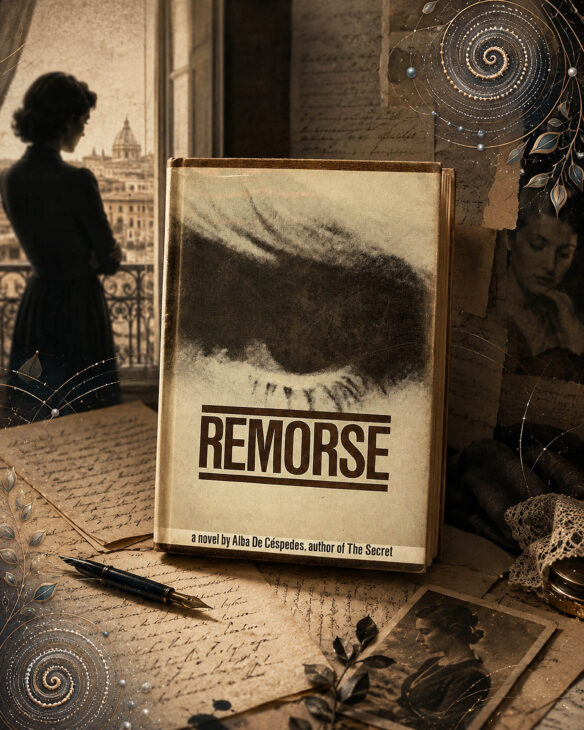
Now, Alba is returning as a feminist, a revolutionary, and a writer who told the story of Italy and people trying to find themselves and live differently. Her works are being republished once again.
I feel that this time, “Remorse” was more of a portrait of a country and its people for me, rather than a story of emotions I could personally identify with. I understand the characters’ motives, their desire to be “free,” but their definition of freedom doesn’t always align with mine. Surprisingly, during this reading, I found the “pious-on-show” Isabella the most intriguing – terrified that any scandal might “stick” to her name or family. Her omniscience and knack for giving unsolicited “golden advice” are remarkable, as is her conviction that she has the right to judge others because she is the ultimate moral benchmark…
Aga J. Mackiewicz
for Intensive Chapters
A human, not artificial intelligence, is always responsible for the substantive content and final form of all texts on this website. No text is the result of any advertising partnership. All content represents our own, sometimes subjective, opinions, and no payment has ever influenced them. Photos used in the posts are our own, while graphics are created with the help of AI tools.