


Book Review
Fredrik Backman was a real discovery for me when I read the “Beartown” trilogy – a series about ice hockey. If someone had told me before that I’d rate books about teenagers sliding across rinks with sticks, chasing a black puck, and the entire community of two small Scandinavian towns living for hockey, as the best books of the year (or even the last five years), I’d have tapped my forehead in disbelief. Hockey? Really? I doubt it.
It turns out Backman can write about hockey, but he does it in a way that makes me fall into the world he’s created, and I don’t want to leave. Even though I suspect it might be better for me if I did, because my emotions end up soaring at heights that are dangerous for the heart.
100% Backman in Backman. In other words: a mountain of emotions in the book, and even more in the reader.
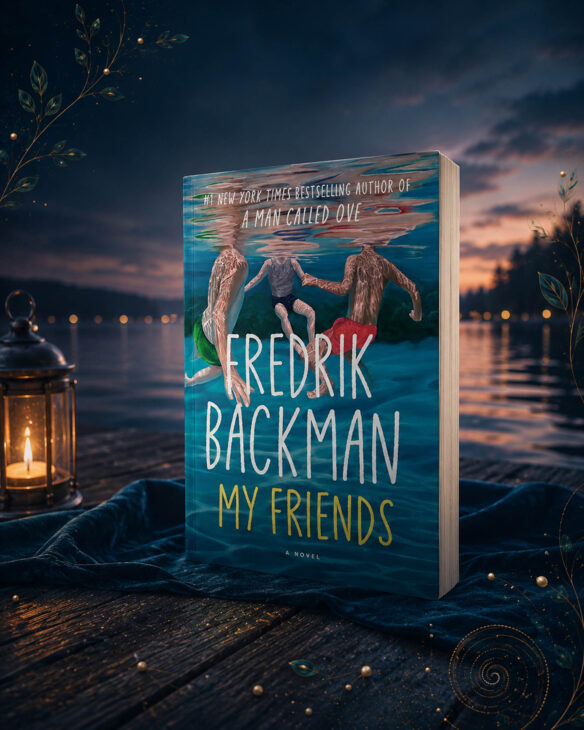
When the English translation of “My Friends” was released, I knew it wouldn’t be long before I’d want to listen to this story, too. And let me tell you one thing – don’t read it in December! In December, you should read or listen to fairytales, warm stories about love, and “cosy” tales of friendship, biscuits, and cocoa. But not Backman! Because with him, you get… life. Raw life, with no euphemisms in the descriptions. Save Backman for the spring, and that’s when you should dive headfirst into his tale – crying, swearing, laughing, and falling into deep reflection.
This time, the story is one of those “extraordinary ordinary” ones – American suburbs, the working class, immigrants, general poverty, and problems behind basically every fence and four walls. But the neighbourhood kids stick together, spending time on the jetty, riding stolen bikes, reading comics, and watching superhero films. Trying at all costs to stay children for just a moment longer, even though life repeatedly demands they grow up well beyond their years. For one, it’s the illness and death of a parent; for another, it’s alcohol and unimaginable violence; for yet another, it’s the disappointment that a child is just so different.
But one of them turns out to be an artistic genius, and years later, his works are the most sought-after items at auctions and the most prized paintings in galleries. It’s at one of these auctions, 25 years later, that we meet Louisa – an eighteen-year-old, also battered by life, who absolutely adores the Artist. She causes a scene at the auction, of course (she wouldn’t be herself otherwise), but her escape marks the beginning of an extraordinary journey. Along the way, she’ll not only uncover the secrets behind one of the Artist’s most famous paintings but also learn about his history, his friends, his town, and that famous jetty.

My impression was that Backman truly outdid himself with this story. He wrote something that gripped you by the throat every single minute. Plus, from the very first pages, you had a feeling – and later, the absolute certainty – that nothing here was going to have a fairytale ending. That this would be a story of pain, failure, loss, and unfulfilled dreams. And that, for me at least, made the listening experience even more emotional. Honestly, I have no idea where Backman gets such a deep insight into the emotions of teenagers. He describes them so vividly that if you’ve had similar life experiences, you literally feel the pain, fear, anger, defiance, aggression, and terror crawling out from deep inside you… everything. I was literally falling to pieces reading Ted’s stories about trying to live in a house where the illness and death of a parent become a shroud covering every inch and every second of life.
Now, a little spoiler – at first, Backman leads us through his narrative in a way that makes you feel like you’re descending into further circles of hell, that things will only be bad, worse, and then horrific. But in the end, it turns out that even in that darkness and hopelessness, there are glimmers of goodness, meaning, and something that can truly flourish – and with a bang! Would I say the author is playing with us by telling the story so we think there’s no hope, and then – boom! Surprise! – he’s tricked us? That was my first thought. I was actually angry at Backman for dragging me through the mud like that. But then I realised it wasn’t him doing it to me… it was me doing it to myself. Because we have a tendency to focus on the bad, the dramatic; that’s what we see, feel, and exaggerate. Those crumbs of light and goodness – yes, we notice them sometimes, but they vanish so quickly. Read Backman in a way that ensures not a single crumb escapes you!
What might be annoying? This is a novel about young people (though not only for them), and teenagers are just the way they are. At times daft, at times loud, sometimes using language that grates on you and laughing at jokes that are beneath them. Backman doesn’t create his characters in the image of some ideal on a pedestal. He “paints” them exactly as they are in reality, and reality is… well, just like that.
Summary – this is not an easy read, especially for those who have something traumatic in their own childhood. But as is typical with Backman – he’ll suck you into his world, put you through the emotional wringer, make you cry a hundred times, then make you laugh a hundred times, and after the final page, you won’t regret a single second of the journey. Because it’s Backman!
And finally… may someone say this to you often: I love you and I believe in you! Today, I’m the one saying it to you.
This novel is packed with psychological themes – many of which are exceptionally difficult and painful. For this reason, I particularly recommend reading it in a safe, comfortable environment, ensuring you have support nearby. If needed, do not hesitate to seek professional help if the subject matter touches upon something that proves too painful or difficult to process on your own. Seeking help in such situations is never a sign of weakness; rather, it is a mark of self-awareness and self-care.
If you’d like to treat “My Friends” as a “case study” for general psychology, it might be interesting to look out for the following themes while reading:
- Autobiographical Memory – Backman’s characters tell their life stories through a subjective lens, revealing only as much as they choose. They often skip uncomfortable facts or withhold certain details. It’s fascinating to track how these narratives are constructed – what is omitted, what is hidden, and why. Pay close attention to the moments they recall their childhood and youth; notice how much they emphasise what they perceive as “good” while remaining guarded about the trauma.
- Social Exchange Theory and Relationship Psychology – Backman has made this group of friends a “collective protagonist”. It’s worth examining the intriguing force that holds people together. As time passes and shared interests or experiences fade, does the relationship endure, loosen, or vanish entirely? Track their interactions and ask yourself: what bound them as children, what held them as teenagers, and what keeps them together now? Is it true connection, or merely a sense of “obligation”?
- Midlife Crisis and Life Audits – Although much of the book focuses on the characters’ younger years, we also see them as adults today. Trace the symptoms of a midlife crisis – who shows them, and who doesn’t? (And why that person specifically?) Furthermore, it’s incredibly interesting to analyse their “what-if” thinking. Do they regret their youthful decisions? How do they feel those choices shaped their current lives? Does their personal “life audit” come out in the black or in the red?
- Defence Mechanisms (Pain, Loss, and Trauma) – Because Backman has written such an emotionally taxing story, he provides us with powerful material for analysing defence mechanisms, such as denial and projection. When you encounter a dialogue that feels “odd,” illogical, or confusing at first, ask yourself if the character is using a mechanism to “escape” overwhelming emotions. This point can be heavy. If you have similar life experiences, you may feel overwhelmed by resurfacing emotions – please ensure you have comfort and support while reading.
- Small-Group Dynamics after Many Years – This is a fascinating and often overlooked area of psychology. What happens when members of a tight-knit group meet after years apart and immediately slip back into old patterns and childhood roles? One person instantly becomes the “jester,” another the leader, one the quiet observer, and another the cynical commentator. Why do you think this happens, and how much of it is driven by a deep-seated need for acceptance?
Now, let’s move into the realm of management psychology and group leadership. Backman provides us with training material that is rarely found elsewhere – examples and suggestions for behaviours and solutions that are difficult to “rehearse” in a real-life setting. Here, they are presented as if in a laboratory. “My Friends” illustrates three key issues:
- Identifying High Potential (HiPo): The group of friends identifies an extraordinary talent in one of their own and decides to do everything in their power to help him develop it and show it to the world. This is a ready-made case study on identifying a “High Potential” individual within a group. We see an optimally organised support team: removing obstacles, motivating, and spotting difficult moments so the individual can achieve mastery. Moreover, it’s an example of where an individual’s success becomes the group’s success. This is rare in reality – not because there are no brilliant individuals, but because we seldom build groups specifically around a High Potential person. Identifying them often fails, and even when we know we have a genius, building a team around them is a difficult and “risky” decision (what if the genius leaves?). It requires non-standard, high-level leadership skills, as the HiPo individual is not the one managing the work. Backman gives a brilliant description of the roles played by each member and the challenges they face.
If you want to read about a famous real-life HiPo case where entire support structures and research groups were built around one person, look up Ian Goodfellow’s history at Google and later Apple. Fascinating. - Hermetic Groups and Cultural Codes: This is a vital yet often overlooked topic – the pros and cons of “siloed” or hermetic groups within an organisation. Backman portrays a group so tightly knit that they develop a unique “cultural code.” This isn’t forced or imposed; the members create and evolve it themselves, seeing it as a vital, bonding element of their identity. Because this code is almost in their DNA, they can instantly identify others with similar values (“he’s one of us”). Of course, trying to force an outsider into such a group is destined to fail. Managing these teams is demanding because their hermetic nature makes it hard to introduce diversity or changes that clash with their code.
A natural, yet incredibly hermetic group is the “pilot caste” in airlines, especially those with a background in military aviation. - Managing “Difficult Cases” and Trauma: This is perhaps the hardest topic – managing groups where members struggle with a painful past, violence, or addiction. A leader in this situation faces a monumental task: the employees’ private experiences cannot be erased or “left at the door.” Yet, these experiences must not define them or limit their opportunities. Backman shows how a traumatic past affects his characters’ professional lives, their decisions, and their ability to stay engaged. You will find plenty of insights into what is painful for such individuals – what they don’t want to hear and what behaviours they find inappropriate. Crucially, Backman beautifully demonstrates that belief in people, combined with the right support, can lead to something extraordinary. However, he also shows that sometimes there is no choice but to say “goodbye.” You cannot help someone who doesn’t want it, and a leader must be – above all – aware of this.
Aga J. Mackiewicz
for Intensive Chapters
A human, not artificial intelligence, is always responsible for the substantive content and final form of all texts on this website. No text is the result of any advertising partnership. All content represents our own, sometimes subjective, opinions, and no payment has ever influenced them. Photos used in the posts are our own, while graphics are created with the help of AI tools.