


Book Review
Fair warning! I’m a bit obsessed with Cleopatra, so this is going to be a long read, but I promise it will be interesting.
Why do we know so little about Cleopatra?
Do you think we know loads about Cleopatra, starting with what she looked like? Think again. We know very little, but she certainly didn’t have the face of Elizabeth Taylor. What did she look like? We don’t know that either.
Why is that? Firstly, because there are virtually no independent Egyptian written sources from that period or from the time immediately after her reign. Secondly, the Romans did a ” black PR”. When Cleopatra lost the war against Octavian Augustus, they deliberately and massively distorted information about her, ruining her reputation as a ruler and portraying her as the biggest scandalmonger of the era.
Cleopatra wasn’t helped by catastrophes either – fires, floods, choose your disaster. The burning of the Library of Alexandria was probably the most devastating loss, as official documents, decrees, and likely the personal diaries and medical notes of Cleopatra herself went up in smoke. What wasn’t destroyed by fire was wiped out by earthquakes and tsunamis that submerged Alexandria’s palace quarter.
I’ll tell you right now: the tomb of Cleopatra and Mark Antony has never been found. We don’t even know for sure where it was. It’s only assumed to be within the palace complex, but other locations are by no means ruled out. And no tomb means no mummy (assuming Cleopatra was even mummified, which we also don’t know) or simply no bodily remains. This means any archaeological or biological research is completely out of the question. Therefore, the question of whether Cleopatra had dark skin remains a controversial suggestion, but it can only be argued academically, as no one holds any actual proof.
A ruler with the brain of a brilliant strategist or an emotional woman on the throne? I lean towards the first option, but making a judgment is by no means easy, as we actually know very little about Cleopatra.
And what was the deal with the Romans’ “black PR”? After the Battle of Actium, Emperor Augustus needed to legitimize his position and power. He could have told the truth – that the conflict with Mark Antony was an internal dispute, essentially a civil war – but that wouldn’t have looked very good. It looked much better to claim that Cleopatra was the “root of all evil” and paint her as a “foreign threat”. After all, no one is going to write that the queen was a brilliant strategist, a political genius, highly educated, and incredibly skilled in languages (she reportedly spoke nine of them). It was much better to write, talk, and repeat ad nauseam that she was a ruthless seductress, a courtesan without morals, and a manipulator without a conscience.
The final factor behind our lack of knowledge is that the most important and detailed accounts of Cleopatra’s life were written decades, and in some cases over a century, after her death. The authors had no Egyptian sources available (even if they had bothered to look for them, which required effort, not to mention the language barrier). Instead, they relied on accounts thoroughly soaked in Roman political propaganda.
Let’s also debunk Cleopatra’s physical image – another area where we know precious little. Yes, reliefs and inscriptions have survived in Egyptian temples, but the problem is that this art is highly formalized and deeply traditional. It doesn’t show real appearance. It shows the concept of a ruler as a god or goddess on earth. Those famous flat profile portraits did not reflect reality. The only direct and reasonably objective source of knowledge about Cleopatra’s appearance are the coins minted during her reign. On them, she is a woman with sharp features and a large nose, and she is no dazzling beauty. But then again, it’s a coin – while the likeness to the original face was intended, it was sometimes hard to capture on a small surface and in such a simple form.
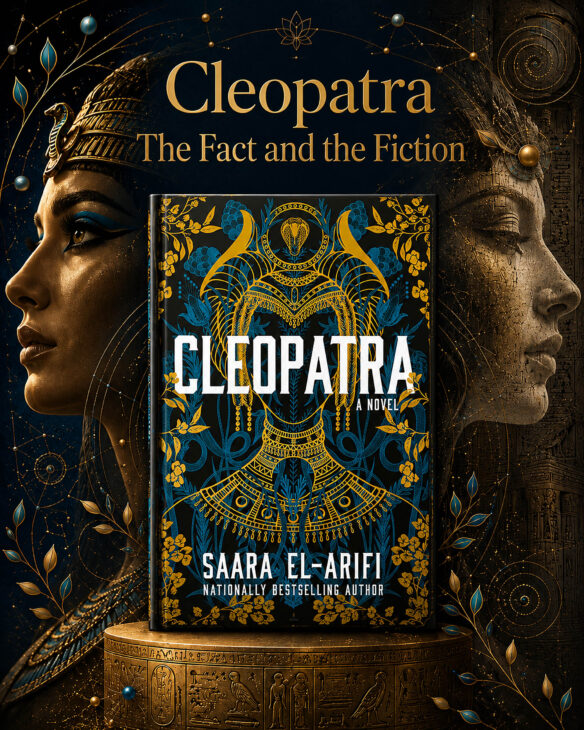
What did Saara El-Arifi do with Cleopatra in her latest novel?
Saara El-Arifi’s “Cleopatra” is a gripping, deeply human, and subtly feminist portrait of the ruler. We meet her at the precise moment she ascends the throne, taking over from her father, and we say our goodbyes after her death.
Critics consider one of the novel’s greatest strengths to be how the author strips away the image of the queen as a mere temptress or courtesan, choosing instead to showcase what a brilliant strategist she was and how deeply she loved her country. Her love affairs with Julius Caesar and Mark Antony also take on a multi-dimensional feel. We don’t just learn why these alliances made perfect sense politically and strategically. We are also thrown headfirst into her emotions – the feelings of a woman who was admired, loving and loved.
If I had to describe the author’s storytelling style in a single word, I wouldn’t hesitate for a second: “cinematic”. We can see and hear these images. They shine and they buzz with the ambient sounds of ancient Alexandria and the ever-present sea. Clothes, jewels, meals, gardens, temples, scents – it’s all there in the novel, and it’s incredibly impressive. We don’t just pop into Cleopatra’s palace for a visit, we also drop by the Mouseion, the Library of Alexandria, and simply wander the streets, the bazaars, the homes of the poorest, the estates of the wealthy, and even the decks of luxurious royal ships.
What might catch you off guard? The fact that the author uses elements of magical realism. It appears throughout the text – subtly, gently hidden behind religion and a belief in magic – but the ending of the novel is quite a realistic-magical firework display. And it works. I promise you, it works.
How authentic is Saara El-Arifi’s Cleopatra?
And here comes my little word of warning. To echo the author herself – she isn’t telling Cleopatra’s history, she is telling her legend. What does that mean? It means that where we actually know something about Cleopatra, that knowledge is used in the book. But where there are blanks, the author fills those gaps with fiction.
An example? I won’t spoil the details so I don’t ruin the read for you, but the scene where Cleopatra finds out that her time has come to take power and heads to the palace is done… in a massive rush. And that rush has consequences. This scene is pure fiction. No documents suggest even in the slightest that things happened this way. In fact, knowing the Egyptian obsession with ceremony, it’s highly improbable. So why does the author invent something like this? Because it underscores her take on what Cleopatra was like, her character, and how she viewed herself and her position.
To sum this point up plainly – you are not getting a historical treatise on Cleopatra based on sources and documents. You are getting her portrait painted by an author who had a specific “artistic vision”.
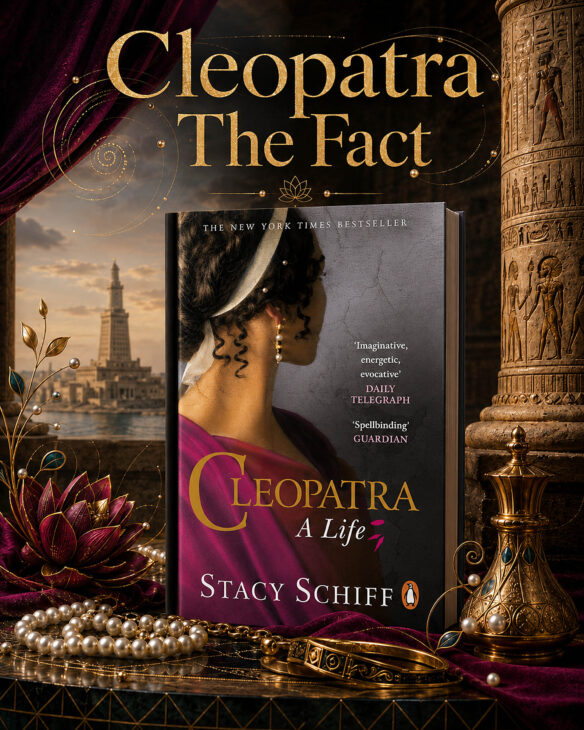
Where to look for information on Cleopatra that doesn’t need filtering through a novelist’s vision?
If you fancy a biography of the ruler written critically and strictly from available sources – keeping in mind when they were written and just how “Roman-PR-heavy” they were – pick up Stacy Schiff’s “Cleopatra”. It is a fairly rigorous academic biography, but written like a good novel. Schiff doesn’t fill blanks and ambiguities with her own hypotheses. She separates fact from guesswork and certainly doesn’t spin tales about Cleopatra’s emotions or inner mid-life crises. However, she definitely dives into her political and state dilemmas, as she isn’t afraid to have a proper row with past historians, calling them out for bias or writing to order. Plus, you get a massive administrative, economic, and cultural backdrop of Alexandria and Egypt.
That said, both authors present Cleopatra as a pragmatic strategist, a brilliant manager, an economist, and a political visionary who treated contacts with Rome primarily as a task-focused mission – protect Egypt. El-Arifi simply adds that deeper layer of sensitivity, ambition, and passion.
Two scenes from Cleopatra’s life through the eyes of two authors
Two famous scenes involving Mark Antony and Cleopatra – the fishing trip and the Egyptian version of the girl with a pearl earring. Let’s take a quick look at how both authors handled them.
The Greek writer Plutarch, in his “Life of Antony”, describes the famous fishing scene. And no, it’s not as if the royal couple grabbed some rods and walked down to the river or lake. It wasn’t that simple. A ship and “an intimate gathering: 60 female dancers, 40 male dancers, and 300 easily digestible dishes”*** – that is a quote, of course, but it captures the vibe of their everyday life back then rather well. Let’s look at how Plutarch actually described it.
Mark Antony was feeling pretty frustrated because he couldn’t catch a thing. He didn’t handle failure well, even when it came to fishing. Plus, he wanted to impress his partner. He quietly ordered some divers to swim under the boat and hook fish onto his line. Cleopatra saw right through the manoeuvre. Praising Mark Antony, she invited everyone back for another fishing trip the next day. But this time, she sent down her own divers with… a herring, which ended up on the commander’s hook. A stale, salted herring. Everyone burst out laughing, and Cleopatra said quite seriously: “Resign the line, imperator, to the fishermen of Pharos and Canopus. Your game is cities, provinces, and continents.” Beautifully put, wasn’t it?
In Stacy Schiff’s biography, this was proof of Cleopatra’s extraordinary sense of humour and how brilliantly she mocked the great Roman. For the queen, theatre, jokes, and irony were tools used to build political dominance.
In El-Arifi’s book, the very same scene is simply a moment of respite for them both, a rather intimate moment. Cleopatra and Mark Antony laugh and banter. It’s not a demonstration of dominance or a brilliant unmasking of the ruler’s trick.
The second scene everyone knows is the one with the pearl. It was described by Pliny the Elder in his “Natural History” and is considered the most expensive bet in human history.
According to the historian, Cleopatra wanted to impress Mark Antony with Egypt’s wealth and wagered that she could host a dinner costing the astronomical sum of 10 million sesterces (the equivalent of a tonne of silver). The dinner was served – exquisite, but fairly standard by royal standards. Mark Antony was already starting to gloat when Cleopatra ordered a cup of strong vinegar (or sour wine) to be brought to her. She took off a pearl earring (made from the largest pearls in the world, passed down through generations of Egyptian rulers and famous across the ancient world), dropped it into the vessel, and once the pearl dissolved, she drank the mixture. She was stopped just before dissolving the second pearl.
Stacy Schiff begins by taking a critical look at whether this story is scientifically plausible from a chemical standpoint. She describes experiments involving dissolving pearls and highlights that you need either time or heat. She suggests that – if the scene happened at all – it was a brilliantly staged piece of propaganda theatre. Cleopatra might have even hidden the pearl in her mouth or swallowed it, but she made those present at the feast believe that Egypt was a land of unimaginable wealth. A display of extravagance that served a clear purpose.
In El-Arifi’s version, this same scene has a deeper meaning. The queen destroys the heritage of generations of Egyptian rulers to show Mark Antony that what he sees as an unimaginable treasure is… worth much less to her. It’s a clear statement: “I cannot be bought.”
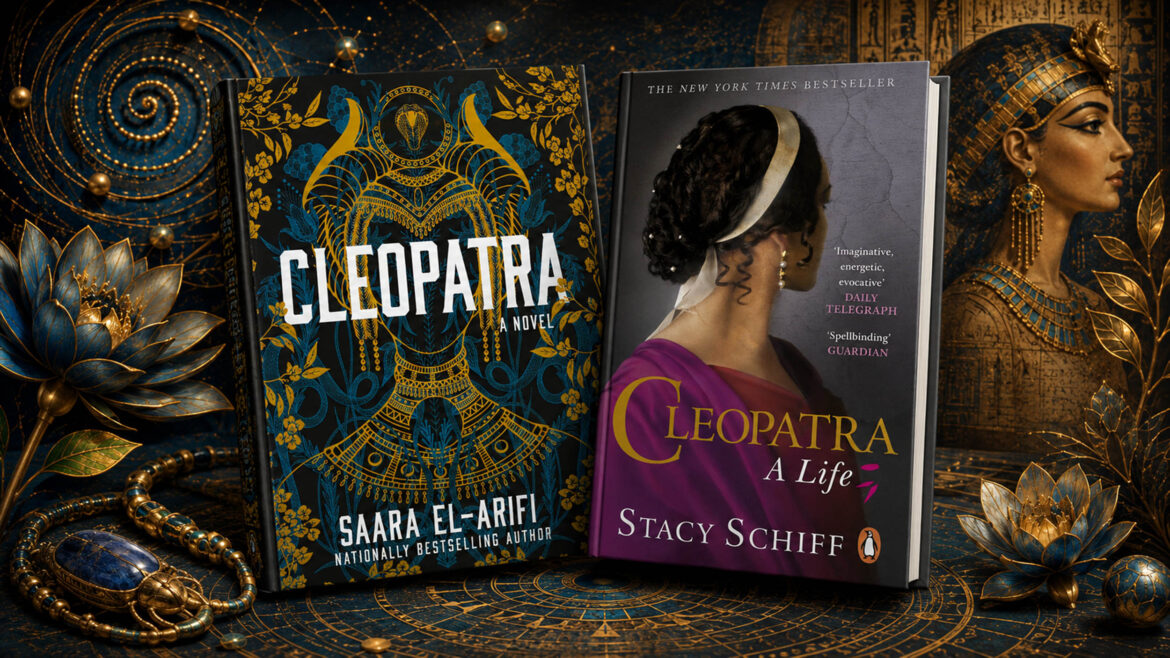
Which Cleopatra do I recommend?
Both! El-Arifi will give you a beautifully written, fast-flowing story about a ruler who was human to the core. Schiff will precisely point out what we know, what we can guess, and what is pure legend. And if you read about Cleopatra in the novel first, and then pick up the biography, I promise you it is an incredible detective journey worth treating yourself to. You’ll be reading the biography with bated breath, discovering what in the novel was true, what was a half-truth, and what was Saara El-Arifi’s own invention.
*** I’m sorry, I couldn’t help myself – this is a quote from the film Asterix & Obelix: Mission Cleopatra, which I absolutely adore.
If you are in the mood for immersive or multisensory reading, here is a quick reminder that you have access to music inspired by ancient Alexandria, perfect as a background soundtrack for reading both ‘Cleopatra’ books. Below, you will find the link to the album ‘Ink of Antiquity. Reading Companion Music’ on Spotify, as well as a link to our post explaining what immersive and multisensory reading is all about.
And for those interested in management theory and psychology, we have something special – materials from the ‘Read Between the Lines’ series. Read Cleopatra with us from a completely different perspective and analyse how a new leader should prepare a takeover strategy for a company with a long-standing tradition.
Aga J. Mackiewicz
for Intensive Chapters
A human, not artificial intelligence, is always responsible for the substantive content and final form of all texts on this website. No text is the result of any advertising partnership. All content represents our own, sometimes subjective, opinions, and no payment has ever influenced them. Photos used in the posts are our own, while graphics are created with the help of AI tools.