


Book Review
A self-service laundry is a phenomenon almost unknown in my country and rather unpopular here. You walk in, toss your things into the machine, and wait for the wash and dry cycle to finish. This means peace, time for reflection, and being alone with yourself. Or, perhaps, with a neighbour – someone more or less familiar – who is also waiting. In the Yeonnam-dong laundry, you also find coffee, a table, and a large notebook or journal that someone left behind. This journal is the heart of our story. Over time, the regulars start using it as a way to anonymously share their problems, their pains, and the things they struggle to handle. Others who drop by respond, usually writing something that helps even just a little, but certainly lifts the spirit.
Is this story plausible? Actually, that’s not the point at all – it’s about whether it’s helpful. But I’ll let you in on a secret – it’s both helpful and plausible.
Kim Jiyun’s novel consists of several stories about various characters, but unlike, for instance, the Japanese “What You Are Looking For Is in the Library”, these tales quickly merge into a single, cohesive story of neighbours who stop being anonymous to one another. They begin to help each other and truly notice one another. On top of that, there’s a sketch of a mysterious figure in our journal. I won’t be giving much away by saying it’s someone who turns out to be the villain of the story and becomes the target of a very well-organized neighbourhood effort to catch a criminal.
I gave the book a very strong 8/10. It was truly engrossing because it’s a tale of fairly universal human experiences, made even more special by the author’s touch of the exotic.
What is so wonderfully universal about “Yeonnam-dong’s Smiley Laundromat”? Well, we have a Korean author and Seoul as the setting. We have thoroughly Korean characters of various ages and levels of attachment to tradition, yet the author has managed to create a novel that doesn’t feel culturally distant or foreign. On the contrary – a European reader will find themselves perfectly at home in this tangle of emotions, dramas, and experiences. Any “cultural adjustments” or shifts in perspective you need to make while reading only add colour and allow for a better understanding of the Asian soul.

A little fun fact – when I was looking for the first bits of information about this novel, I noticed it being described as “healing literature.” I was incredibly curious about how “cosy” relates to this “healing” genre, which was new to me. After reading the book, I now understand the difference, and it’s quite significant – for sensitive readers, it might even be crucial.
Recent years, with their omnipresent stress, chaos, sensory overload, and various crises, have made us reach more often for books that don’t irritate or overstimulate, but rather soothe. Leading the way is “cosy” literature, which is meant to be like a mug of hot cocoa on an autumn evening – providing a sense of security, being pleasant and comfortable. Stories in this genre are gentle, devoid of brutality. There are no massive dramas or emotions that are hard to swallow. There is peace and room to breathe.
“Healing” is a completely different approach. These are stories full of emotions, traumas, and difficult issues. Take our “Yeonnam-dong’s Smiley Laundromat” – we have the loneliness of old age after losing a beloved partner and we have very difficult parent-child relationships. We have the feeling of being a bad parent or a bad spouse. We have financial troubles. We have intense emotions related to work, promotions, and achievements. Finally, we have everything connected to the feeling of inadequacy. We even have suicide, because life has completely lost its meaning.
“Healing” novels work like pulling off a bandage – reading them hurts, but they do so to heal. They tackle difficult topics authentically and powerfully, but with the goal of providing an opportunity to process them. By reading the characters’ stories, we gain hope that something might actually change. They force reflections – sometimes very difficult ones – but they show that even the deepest wounds can be treated. These are books you can reach for as a form of support, but with great mindfulness and care for your own emotions while reading. They should be a remedy for the world’s ills, not salt rubbed into wounds. This is the kind of novel where I will always say – take care of your comfort while reading and, if necessary, seek support if the emotions become too intense, even if you want to see them through.
On a side note – where did this popularity of “cosy” and “healing” trends come from? Because we need a sense of security (which “cosy” provides) and a sense of meaning (which “healing” offers). We need what soothes and what cures. It’s also a way of searching for a remedy for emotional burnout, for the fatigue caused by the flood of information (mostly bad and dramatic), and for the constant feeling that we have to achieve something, “deliver,” succeed, and prove ourselves to everyone. These books often show that the source of happiness may lie elsewhere – that we don’t have to compete, that we can support and be supported.
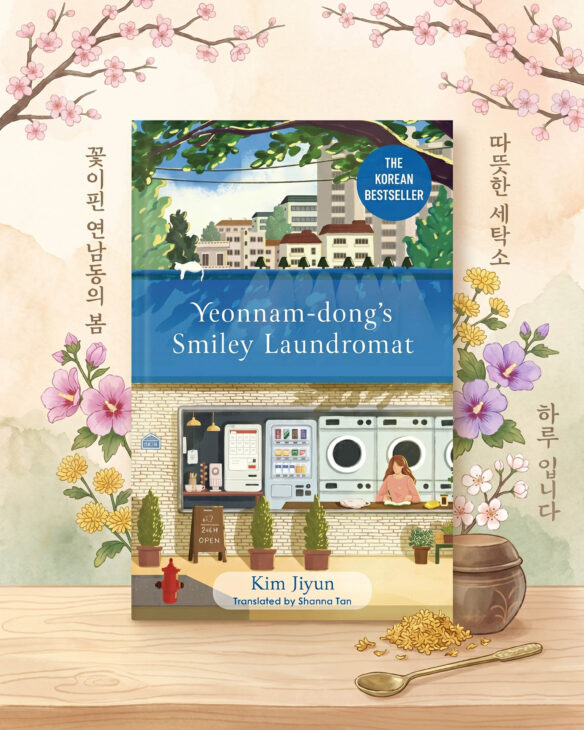
And I very, very, very much liked the statement that neither “cosy” nor “healing” will change the world. But they can change us, the readers. They can give us space for joy and a breather, or for a good cry and regeneration. They give us the feeling that being ourselves is a great act of courage, but also something we deserve and something that serves us well. You know perfectly well that I never use terms like “you should,” and I even try not to write that something is “worth it,” but I will end this – typically long – post by saying that I enjoyed it. I’d love to have a laundry like that, or rather, such neighbours who visit it and actually see the people around them. In the process, I learned through a very good example what “healing literature” is, and I find it valuable – albeit difficult if it touches on emotions I need to process within myself.
Aga J. Mackiewicz
for Intensive Chapters
A human, not artificial intelligence, is always responsible for the substantive content and final form of all texts on this website. No text is the result of any advertising partnership. All content represents our own, sometimes subjective, opinions, and no payment has ever influenced them. Photos used in the posts are our own, while graphics are created with the help of AI tools.
1 Comment