

Book Review
My reviews always live inside my head for a few days before I write them. I rarely sit down to write straight away, my thoughts hardly ever make it into a Word file while they are still fresh. Usually, I need a few days, sometimes even more than a week, to process my own impressions and emotions. The draft of the review matures, shapes itself into something coherent, and only then do I sit down to write.
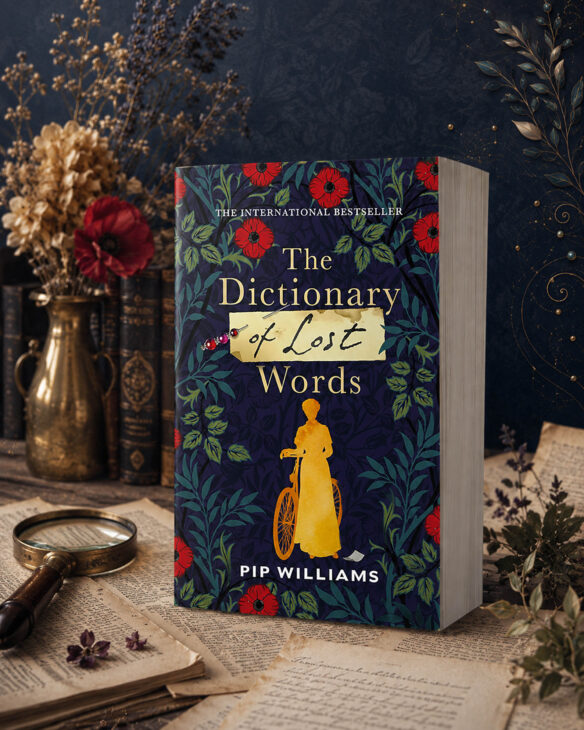
In the case of Pip Williams’s ‘The Dictionary of Lost Words’, one particular question kept bothering me: what should I call this piece? How could I sum it up in a single phrase? Then, it finally hit me – a linguistic love story! Because language, words, collecting them, and protecting them from being omitted or forgotten are the heroine’s ultimate passion. This is a story about love!
– Can you write about the creation of a single dictionary in a way that makes the readers feel like they are reading a romance novel, where people are the characters and words are the object of affection? You absolutely can!
Let’s start properly with a plot summary. The novel is set in Oxford at the turn of the 20th century and is a fictionalised account of the creation of the first edition of the Oxford English Dictionary. By using the perspective of a very young woman involved in the work, the author allows us to see something perhaps unexpected in the world of linguistics – the fact that when language is defined by men, it marginalises the experiences of women and the lower social classes.
We meet Esme (a fictional character) as a child who, having lost her mother, grows up under the tables of the Scriptorium – a garden shed in Oxford where her father, a member of the lexicographical team, works on collecting and editing the definitions of every English word. One day, the little girl finds a slip of paper dropped (intentionally, as it turns out) by one of the linguists. Why? Because the word is deemed “unworthy” of being in the dictionary. We soon learn that it is not the only one. What is the word? “Bondmaid”. Esme starts actively collecting words for her own dictionary – words that are considered inappropriate or too common, and which, by some strange coincidence, are connected to the experiences of women, the poor, and the marginalised.
In the novel, we live at the pace of Esme growing up and growing old, alongside the creation of the dictionary. We start during the reign of Queen Victoria, we accompany women through the turbulent rise of the suffragette movement fighting for women’s rights, and we live through the First World War, which leaves a dramatic mark on the characters’ emotions. Together with Esme, we experience successes, failures, losses, and tragedies, we watch the consequences of her decisions, which are often difficult, root for her love life, and mourn her heartbreaks.
For Esme herself, a word is not just a dry entry in a dictionary. She grows up surrounded by words. She feeds on them, is fascinated by their sound and meaning, and her word collecting feels a bit like falling in love – moving from childhood fascination, through teenage obsession, to mature, sensible actions to ensure that words are neither omitted nor forgotten. Even her real-life love story, her love for Gareth, a printing house worker, is inextricably linked to their shared respect for letters, paper, and the craft of book publishing.
But let me warn you about one thing – there is plenty of emotion here, but the plot is not fast-paced. Nothing happens quickly, abruptly, or even particularly surprisingly. This is, first and foremost, a story about the creation of consecutive volumes of a dictionary – about slow, painstaking, and repetitive work. The rhythm of the book reflects the rhythm of the work in the Scriptorium, so anyone who likes dynamic historical fiction will find themselves yawning. Because here, the main character is, after all, the word. This text will be loved by anyone with the soul of a linguist, who can see beauty in a simple expression or sentence.
Time for some interesting facts.
First of all, if you were enchanted by ‘The Dictionary of Lost Words’, the author has written a second novel called ‘The Bookbinder’. It is set in the same world, capturing the reality of England during the First World War through the eyes of sisters working in a bindery.
Secondly, if you are wondering why a thoroughly English novel features so many Australian threads, it is worth knowing that Pip Williams was born in London but grew up in Australia, where she still lives today.
Thirdly, while the author herself absolutely loves language and words, she was diagnosed with dyslexia as a child. She openly admits that her school days were difficult, but what frustrated her most was the advice to “just look it up in the dictionary” whenever she didn’t know how to spell something. For her, a dictionary was a forest of incomprehensible symbols and words – after all, if you don’t know how a word is spelt, you can’t even find it! Yet, paradoxically, one of her greatest passions grew out of this very struggle.
Fourthly, Pip Williams has admitted in interviews that reading Simon Winchester’s ‘The Professor and the Madman’ was the catalyst that drove her to write (I’ve read it myself, if you fancy more stories about the creation of the Oxford dictionary, it’s well worth picking up, or you can watch the film adaptation). While she was captivated by the book, she immediately noticed that women were entirely absent from the story of the dictionary’s creation – nobody had considered their perspective. She decided to fill this gap, guided by two main questions. Do words mean the same thing to men as they do to women? And by defining English solely through the lens of male scholars, is something being lost forever? Later on, she discovered the history of the aforementioned word “bondmaid”. It turned out that in the first edition, words were rejected not only by accident or mistake – which is hardly surprising given the scale of the project – but also because they were deemed inelegant, taboo, or irrelevant to academic discourse, often because they related to women’s lives, physiology, or intimacy (let’s not forget the era we are talking about). They were used by the lower classes, they belonged to the marketplace and the streets, and they lacked a printed source – which was frequently a requirement for a word to be included.
Fifthly, it is worth knowing that while Esme is a fictional character, the other women in the novel were real. Eleanor Bradley and Edith Thompson actually existed, worked on the dictionary, and made a huge contribution. Yet the “academic elite” of the time – the ones in trousers – pushed them to the absolute margins. The scene describing the banquet held to celebrate the publication of the final volume, where the women were invited only to be led up to the balcony to watch the event from afar, is not made up. It is a historical fact – gender segregation in full swing.
Is this a novel worth your time? Yes. It tells a piece of history that is rarely discussed. However, I think it will most delight lovers of stories about language and words – people who keep old dictionaries on their shelves and peer into them from time to time, with a sense of sentimentality and love for something that has largely faded away in the age of the internet and artificial intelligence. But it will also be a fascinating read for those who love history told from a female perspective, with respect for women’s roles in creating major works and projects – roles that are often silenced or diminished. And finally, for anyone intrigued by life in the Victorian era and the First World War, as Pip Williams has also given us a deep, detailed portrait of everyday life across different social classes – what people wore, what they ate, how they raised their children, and how they spent their Saturday afternoons.
Aga J. Mackiewicz
for Intensive Chapters
A human, not artificial intelligence, is always responsible for the substantive content and final form of all texts on this website. No text is the result of any advertising partnership. All content represents our own, sometimes subjective, opinions, and no payment has ever influenced them. Photos used in the posts are our own, while graphics are created with the help of AI tools.