

Book Review
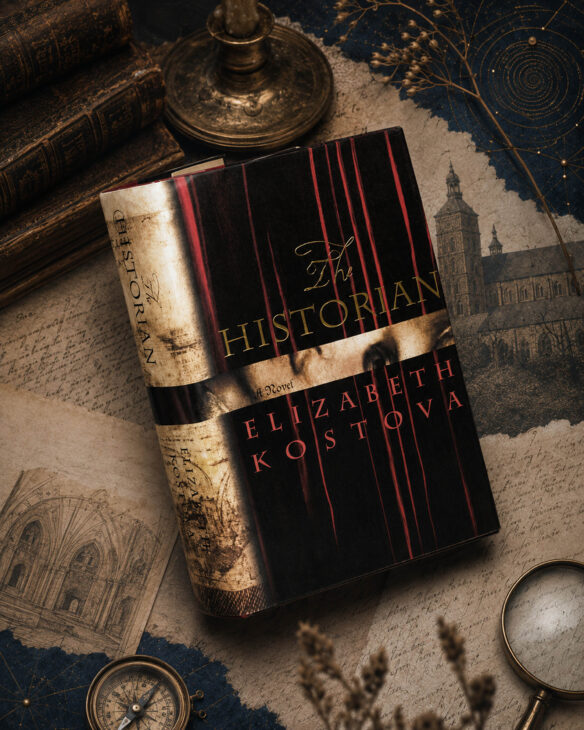
For me, Elizabeth Kostova’s novel will be this year’s synonym for a laborious slog through pages and chapters. Not because it is bad or weak, but because its form and content give the reader the impression of wading through dozens of pages of letters, descriptions, and academic notes. The promised vampire thriller turns instead into a travel diary of Europe mixed with an epistolary novel, as there is far more correspondence in this text than you would ever anticipate.
The plot? Quite intriguing – as it turns out, evil in the form of Dracula was not destroyed at all, and the brutal figure from the past is still alive… Well, actually, he isn’t alive… Correction, then – he still exists, enslaving people who might be useful to him and attacking those who threaten his centuries-old existence. By a strange twist of fate, the most fierce enemies of the vampiric ruler are historians, academics, archivists, and librarians – the very people with access to knowledge. When one of them, Professor Rossi, vanishes under dramatic and highly mysterious circumstances, his postgraduate student, Paul, sets off to find him, tangling both himself and his underage daughter in an affair that quite literally threatens their lives. Sounds like a thriller? Like a fast-paced, slickly told story? It might sound like one, but Elizabeth Kostova had other ideas.
Elizabeth Kostova has taken a well-known classic vampire tale, dropped it into the academic world, and sent the reader on a journey across Europe – or rather, through European libraries, cloisters, and monasteries. Is it an interesting journey? Let me put it this way: it is definitely not what you would expect.
The author of “The Historian” used an epistolary structure, packing it with pages upon pages of historical documents that the characters discover, unearth from the depths of archives, read, and pass on to one another like treasure. And yes, I agree with the claim that each subsequent layer of letters, archival records, and diaries helps unveil another level of the mystery and solve another little piece of the vampire puzzle. However, the pacing is… exactly what you would expect from working inside the archives.
Why did Kostova decide against writing a traditional novel, even though it practically begged to be a fast, breathtaking thriller?
Firstly, she wanted to tip her hat to the classic “Dracula”, as Bram Stoker built his novel out of press clippings, diary entries, and letters from the characters. Kostova modernized this form slightly, blending a first-person narrative (by the main protagonist, who was a teenager when the novel’s core events took place) with a multi-layered archive of letters and documents. Mind you, it should come as no surprise that these letters are like a Russian matryoshka doll. You see, Professor Rossi writes to his PhD student Paul, who years later recounts a section of the story and quotes the original letter to his daughter – doing so, of course… in a letter to her. It is like a multi-generational passing of the baton in a relay race of Dracula obsession.
Secondly, the epistolary form allowed the author to consciously control and literally manipulate the timeline. Our underage narrator finds her father’s letters from 1972, but they describe events from the 1930s and 1950s, referencing correspondence from that period and pointing back to 15th-century materials. Thanks to this, we travel through time seamlessly alongside the characters without the need for clunky explanations of when things happened, as we know it directly from the text. But this also leads to something highly implausible – here we have our young narrator quoting her father’s words, who in turn quotes from memory a letter from his professor – a long, complex letter received decades earlier. Photographic memory for every single character is rather unlikely, so we are left with something comically artificial and far-fetched.
And that is just one of the problems caused by this correspondence “matryoshka doll”, and these issues are often raised as criticisms of the novel.
Firstly, many people find the book overly wordy and too long. They feel that during the final editing stage, a rather ruthless editor was badly needed to suggest sharp cuts. Why? Because Kostova can dedicate entire pages to descriptions of architecture, food, and travel, which drags down the already leisurely pace of the plot. On one hand, I agree that there are slow patches, but they do have their charms – you can literally see these places, buildings, and cafes in your mind’s eye. Hungary, Romania, and Istanbul are filled with colour, scents, and sounds. If you dismiss the idea that this is supposed to be a thriller, I’m not at all sure I would actually want them cut during editing. It truly builds an atmosphere and brings a lot of joy to readers who love travelling in their imagination.
However, I do agree with a different point. For 600 pages, we chase Dracula across the whole of Europe; people die, get bitten by the undead, and characters vanish under bizarre circumstances. Yet, when Dracula finally shows up… let’s just say the expected fireworks turn out to be more like a sparkler – specifically, a single sparkler lit for three seconds. After all the effort from the characters and the dangers they have experienced over decades, the ending is simply too weak and fails to stir up much emotion.
Another criticism, which in my opinion is a major one and affects the enjoyment of reading the novel, is that the author failed to differentiate the characters’ voices. As a result, we have a situation where an elderly professor’s letter to his PhD student, a conversation between a father and daughter, and the journals of a 1970s teenager sound almost identical. What’s more, they all read like a formal, academic style of communication, which looks laughable at times and often incredibly artificial.
Now, for the sake of balance, here is something everyone agrees is a massive strength of the novel, which I briefly touched upon earlier: the cities, regions, libraries, and monasteries – basically, how Kostova handled the geography. It is worth highlighting that her research took years and included travel. The fact that her Bulgarian husband helped her is not without significance either. Not only was he able to verify most of the factual matters, but he was also happy to share stories about the realities of life in the Eastern Bloc. But back to geography. The descriptions of cities, universities, alleys, and libraries are realistic and could even serve as travel guides for visiting various spots in Europe and Asia Minor. When it comes to places tied to Dracula himself, we enter an interesting territory. Lake Snagov and the monastery there are authentic. However, all the climax points of Kostova’s story take place in fictional locations, though they are based on existing cloisters and monasteries. Why is that? The author was a bit worried that she would unleash hordes of Dracula fans upon the monks, disrupting their peace. Was she right? I don’t know, but you have to give her credit for one thing – both the real and the fictional places are described with the exact same talent.
And now for a curious fact related to the first edition of “The Historian”. When Kostova finished working on the novel in January 2004 (yes, this book is over 20 years old now!), she sent it to her literary agent, and something happened that I don’t think either of them expected. The major publishers sensed they were being offered a historical novel where characters flee from someone, hunt someone down, there is a thrill of excitement, and it could be marketed under the banner of a “thriller”. A bidding war broke out over the publishing rights. Ultimately, the rights were auctioned off to Little, Brown and Company, who paid an astronomical sum of 2 million dollars. At the time, the standard for a debut writer was around 30,000. Why did something so incredible happen? Kostova should thank Dan Brown – and thank him warmly and sincerely. When her novel proposal arrived, the market was in the grip of “The Da Vinci Code” mania. Everyone was reading it, everyone was travelling to locations tied to the story, everyone loved the characters. Publishers saw “The Historian” as a chance to replicate that success. And maybe it’s a bit cynical of me, but I will say that they seemingly failed to notice that while these two novels might both reference historical mysteries that impact the lives of modern characters and force them into action, the writing style… is like chalk and cheese when it comes to plot construction, the language used, the pacing of the entire story, and even the amount of dialogue. It was never going to work. The publisher even came up with the idea that since it couldn’t genuinely be called the second “The Da Vinci Code”, they would play the readers… the book was advertised as the intelligent successor to “The Da Vinci Code”. The trouble was, readers quickly began to realize that this is nothing much than some promotional nonsense. Kostova did not become the next Dan Brown, but she didn’t have to. “The Historian” doesn’t need to be “the next” anything; it has its own vibe, and many readers adore it for precisely that uniqueness: its pace, its style of writing, and the way it draws the reader into the whole story.
The final curious fact is also probably the biggest blunder left in the book, missed by the author, the editor, and even the proofreader (though the latter wasn’t obligated to catch it, as it’s not their department). But it is something that causes quite a bit of amusement. In the novel, two brilliant historians investigating Dracula are desperately waiting for the chance to borrow the university library’s single copy of a book. One of them even points out that his progress is being delayed because the other has the volume in question and won’t return it. A library tragedy! The issue lies in what this coveted volume, this Holy Grail of Dracula documentation, actually is… it’s Bram Stoker’s novel “Dracula”. A single copy in the library… and not one intellectual thinks to visit another library, or, better yet, a bookshop… I asked an artificial intelligence to estimate some rough figures for how many copies of this title have been published from its release to the present day – which is obviously difficult for many reasons, but just to give us a general idea – tens of millions of copies have been published in English in total. And in the 1970s alone, over 7 million copies were put on the market in English. Yet the poor professor couldn’t conduct his research because he didn’t have the book.
The final verdict? Firstly, I don’t regret the time spent with the professors hunting Dracula. Admittedly, where you expect a chase, danger, and a thriller, you instead get descriptions of long hours spent in a library, or conversations about Turkish dishes or coffee while the “enemy” is creeping around right next door – but then, one must have priorities, and for a Turk, coffee will always beat everything else. But in return, you get such a mosaic of descriptions of sights, tastes, smells, colours, textures, places, and nature that you can’t help but be charmed by it (but I repeat – only when you forget for long stretches that this is supposed to be a thriller). Furthermore, the sections describing life in Eastern Europe at that time are incredibly intriguing: the regime, the surveillance, the bureaucracy, and the social contrasts between the “blooming” socialist city and the impoverished countryside trying to preserve elements of local culture. It is truly fascinating, and I wonder if at times it isn’t more frightening than the vampire story.
Aga J. Mackiewicz
for Intensive Chapters
A human, not artificial intelligence, is always responsible for the substantive content and final form of all texts on this website. No text is the result of any advertising partnership. All content represents our own, sometimes subjective, opinions, and no payment has ever influenced them. Photos used in the posts are our own, while graphics are created with the help of AI tools.