

Thoughts and Ramblings
You’re at an age where the only excuse for reading novels aimed at kids and young teens is reading them to your own grandchildren. Except you don’t have any. Day to day, you read “adult” fiction, or maybe the occasional book labelled as “young adult” – but then you quickly explain that it’s fantasy and features dragons, and you just happen to love dragons. Reading something recommended for ten-year-olds might seem pointless at best. At worst, someone might tell you that you’ve reached that age… you’re losing your marbles. But let me put it bluntly: going intentionally childish has its perks! Go childish often, enjoy it, and feel zero guilt.
It was a complete accident, but I see it as a brilliant stroke of luck. Thanks to it, I’ve now ticked off two highly interesting, wise, and valuable examples of children’s fiction – the kind that does a world of good for an adult’s mind, too.
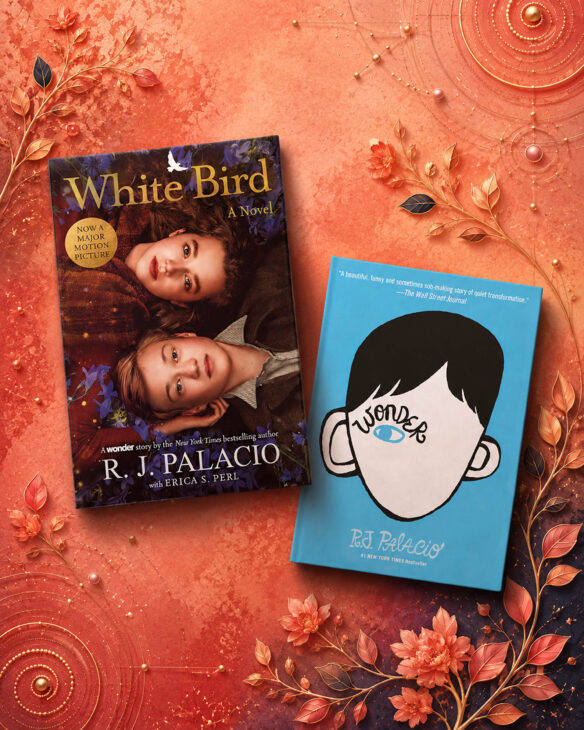
Where did this whole topic come from? Andrzej picked R.J. Palacio and E.S. Perl’s “White Bird” out of the lottery tin for me (you’ll find short reviews of both books mentioned here at the end of the text). I was delighted because I wouldn’t have reached for it on my own anytime soon – which is obvious, given that years have passed since its release and it was still sitting on my shelf. I started it with a bit of scepticism. I figured it was short, so if it turned out to be a disappointment, I wouldn’t suffer for long. But after the first few chapters, I fell completely head over heels. I fell in love with the storytelling style, the emotions, and the characters. And yes, it’s a children’s book, the language is simple. The emotions are described clearly and without euphemisms so a child can understand. The plot is straightforward without extra subplots, but it’s wise, truly wise.
And since “White Bird” mentions another character who appears in “Wonder”, I immediately pulled that novel off the shelf as well. Another bullseye. That said, knowing what to expect this time, I looked at it a bit more calmly, and one thing really stands out – these are therapeutic books. They are perfect for reading with your kids to educate them, talk to them, help them identify and name emotions, build empathy, avoid stereotyping, and maintain independence within a peer group when they have a different, perhaps unpopular opinion, idea, or need.

So, now you know that I happily went a bit childish. But if you need a more “scientific excuse”, here you go.
Good, wise children’s books read by adults offer a profound, often transformative psychological experience. We see far more layers in them than a child does. But in my opinion, that’s not even the most valuable part.
As adults, we put on protective armour every single day. We grow indifferent to many things, maybe even cynical at times, because otherwise, life would simply hurt too much. Yet the simple, unpretentious message we find in children’s books acts on us like an emotional reset. It cures us of that cynicism and becomes a remedy for “empathy burnout”. On top of that, it reminds us that the world can be simple, and that selflessness, paying attention to another human being, and the weight of small gestures or a smile really do exist.
For many adults, the school or family stories in these novels can work as a form of therapy, finally allowing them to confront their own traumas. Even more importantly, looking through adult eyes lets us re-examine certain behaviours and finally discover that they were often just defence mechanisms – both ours and other people’s. Sometimes, we might conclude that we’ve been dragging one of these mechanisms along with us for decades, and that it still influences our behaviour today, because we’re still reacting like a six-year-old standing in front of a parent or teacher.
I don’t even need to mention that these novels are textbooks for wise parenting. But let’s assume we’re looking for excuses for adults who don’t have kids around, and let’s focus entirely on them.
To an adult, these novels aren’t just “silly little stories” – they are lessons in mindfulness and the foundational concepts of ethics and humanism. Reading them allows us to slow down, sometimes stop and relax completely for an evening or two. It allows us to be moved, so deeply that we might cry, and to do so without any shame. It lets us look at things more simply, without the adult filter, in a childish way, more with the heart than with a wise, adult head. And it helps us view ourselves and our loved ones with greater compassion, and maybe, sometimes, just let things go.
Oh, and I’ll add one more thing: occasionally, we discover that we’re yearning for something from our own childhood. Ice cream in the park on a Sunday, playing in the rain, wandering through the woods, Lego bricks, painting… It might be worth looking a bit deeper into that longing and returning to some of those activities. Who knows, you might just discover a new-old hobby.
REVIEWS
“White Bird” is a story about France – the parts far from the big cities – and how the Second World War shattered the peace of an ordinary family with Jewish roots. Sara isn’t even fully aware of her family’s heritage, and when the first signs saying “No Jews Allowed” appear on shop doors, she doesn’t completely grasp that this applies to her, too. But she quickly experiences stigmatisation, fear, loss, and pain. In the end, she only survives because she is helped by a classmate who is the most stigmatised of all due to his poverty and disability. It’s a brilliant lesson showing that passivity and indifference to the suffering of others are the first steps toward accepting macro-scale evil. The book is described as a therapeutic-historical novel.
“Wonder” is a contemporary story. August has loving parents, a great older sister, and a life spent mostly in hospital. He was born with a facial deformity that requires numerous surgical interventions, and yet the result will always be that his face triggers disgust, fear, or at the very least, surprise in others. August knows he will never be invisible. Hospitals have effectively stopped him from going to school, but now an opportunity comes along to change that. August both wants it and doesn’t, he’s terrified and excited all at once.
The novel is quite remarkable because it’s told not only from August’s perspective, but also from the viewpoints of his sister, his schoolmates, and people who interact with him even just by chance. There’s a lot of emotion here, along with a wise narrative about differences, acceptance, respect, and support. It also touches deeply on family life when dealing with illness and challenges, on being a sibling who has to grow up fast, and on how much that can hurt.
These two novels are linked by the character of Julian. In “White Bird”, it’s his grandmother telling the wartime story, explaining to her grandson in the present day what life was like back then. Meanwhile, in “Wonder”, Julian is one of August’s bullies. You can read them in any order.
Aga J. Mackiewicz
for Intensive Chapters
A human, not artificial intelligence, is always responsible for the substantive content and final form of all texts on this website. No text is the result of any advertising partnership. All content represents our own, sometimes subjective, opinions, and no payment has ever influenced them. Photos used in the posts are our own, while graphics are created with the help of AI tools.