


Book Review
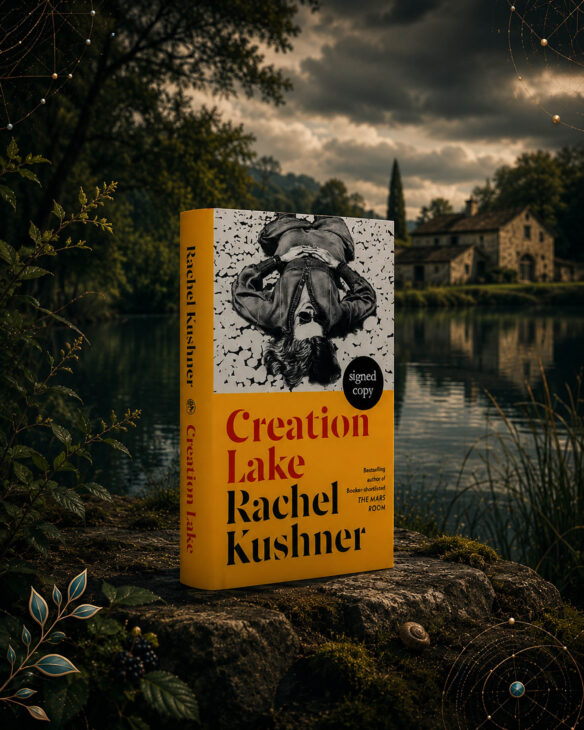
This piece will primarily be about the Booker curse, using Rachel Kushner’s novel “Creation Lake” as our case study. However, I will start with the novel itself, as it is intriguing and highly unusual.
Sadie Smith is the alias currently used by a 34-year-old American woman. She used to work for government agencies, but now she is a freelancer. She has just been hired by mysterious employers to infiltrate “Le Moulin”, a commune of radical eco-activists in France. What does she know about her employers? Very little. Does she know what her ultimate goal is? As it turns out, not entirely either. And what does she know about the people whose ranks she is supposed to join? More, but mostly from intercepted emails written by the activists’ guru, which focus mainly on Neanderthals. Yes, you read that correctly – anthropology plays a significant role here.
Sadie is calculating, highly pragmatic, and cynical. Sex, alcohol, manipulation – to her, these are merely tools of the trade. Whether she uses them is decided not by any work ethics, but by an assessment of efficiency and the profit they might bring. Yet, many readers point out that Sadie’s character is incredibly fascinating. Her cynicism and “get-the-job-done-at-all-costs” attitude evolve, perhaps in a less-than-obvious direction, making her a highly nuanced psychological study.
The sticker announcing that the novel was shortlisted for the Booker Prize acts as a double-edged sword. It deters some, encourages others, but then leads to disappointment. The Booker curse?
An arguably even more interesting and far more mysterious character is Bruno Lacombe, the leader of the activists. A mentor, guru, philosopher, and great apologist for Neanderthals. Bruno has retreated from normal life and moved into a cave. He only appears “among civilisation” from time to time to write emails answering questions from his followers, and then disappears back into the darkness. More on the Neanderthals in a moment, for now, let’s talk about the caves.
The entire novel is set in the French region of Guyenne, known for having the highest concentration of Palaeolithic caves. This is where arguably the most famous of them all is located – Lascaux, home to the well-known cave paintings. Although those happen to be the work of Homo sapiens – as Neanderthals didn’t leave behind many examples of painted art, their creations were more “architectural”, along with handprints and rock carvings. However, these caves become mythical in the novel, almost as if the author intended for them to be an inanimate character in their own right.
Let’s return to the Neanderthals. Bruno believes that the emergence of Homo sapiens was the greatest evil to ever befall humanity. This is because Homo sapiens chose the wrong path of development – one dominated by violence, warfare, greed, and the creation of tools that could double as weapons. It has been rolling in this wrong direction for millennia, and the only way to save ourselves is to return to the Neanderthal perception of life, time, and space.
His activist commune doesn’t exactly live like Neanderthals, but it practises agriculture, tries to support local farmers, and corresponds with the guru via email. Meanwhile, Sadie’s employers are convinced that this group is involved in sabotaging the operations of corporations. These corporations intend to build mega-reservoirs to supply large-scale industrial farms, which will disrupt the region’s water balance and, naturally, harm the smallest local farmers. At least, that is the starting point when we first meet Sadie.
Time for the fundamental question – what are we actually reading when we pick up “Creation Lake”? The book is marketed as a thriller-slash-spy-novel. There is one problem, however. The novel might start that way, and a seed of action does appear, but it quickly gives way to monologues, philosophical essays, historical digressions, and tangents about the sex lives of children and teenagers. This doesn’t just slow the action down, at times, it brings it to a grinding halt.
The conclusion? Reading the blurb and the marketing texts, the reader is convinced they are getting a spy thriller, something akin to James Bond. And yes, it’s a Booker book, so perhaps it will be more intellectual, maybe a bit more philosophical, but there will be action, plenty of danger, some spectacular twists, the eco-activists will probably blow something up, and the special agent Sadie Smith will be crafty, cunning, and clever.
And what does the reader actually get? In my view – a provocative, highly intelligent, and witty tale about where we are heading as a human race and how far we are drifting from our roots. At the same time, it shows how difficult it is to return to those roots, and how those who try sometimes end up looking ridiculous or pathetic. There is essentially no classic plot progression here, the narrative focuses on the very leisurely observation and infiltration of a farming commune and the reading of emails. Instead, there is an abundance of texts on anthropology, the history of the French left, the rot of capitalism, and stories from the time when Neanderthals lived side by side with Homo sapiens.
This is not a book that will suck you in. It may intrigue and fascinate you, but you won’t be swept up in a whirlwind of action, because there isn’t any in the full sense of the word. Oh, and the ending… I won’t spoil it, but it isn’t a classic thriller ending either.
Has “Creation Lake” fallen victim to the Booker curse? In my opinion, yes, but in this case, the curse is amplified by the publishers and their marketing departments – more on that in a moment.
When you read the opinions of the average reader, you see how the “Booker” sticker on the cover of any novel affects them. It doesn’t matter if it says it was shortlisted, longlisted, or that it won – for many, it acts as an incentive, while for many others, it’s a warning.
People who don’t really have a clue what the Booker Prize is see such a sticker and get the impression that it’s something “extra”, it has won an award, so it’s no longer just an anonymous title in the mass of published novels. It will make a good gift. It will be a good holiday read (especially when the marketing department writes that it’s a thriller or a family saga, but conveniently omits the fact that it’s dominated by philosophical or socio-political elements).
Those who are familiar with the Booker see it as a “stamp of quality” – this story must have something unique, it’s probably more intellectual, but it is certainly something more than the vast majority of published novels. And this is where the famous “publisher’s blurb” comes in, leading to a clash between expectations and reality. It was supposed to be a thriller, but instead, it turns out to be an email correspondence that, while perhaps interesting, is severely lacking in “action” – sticking with “Creation Lake” as our example. What happens then? Many people won’t finish the novel and will leave critical reviews online – “Nothing happens in this book!” – and it’s fair to say they will feel cheated. This is the group that falls into the Booker trap, baited by the “blurb writers”.
There is also the group of readers for whom the “Booker” sticker acts as a warning – that it will be too difficult, too intellectual, too eccentric. They won’t buy it because they want something easy, simple, and undemanding. They want to unwind after a hard day, not ponder philosophical reflections on the hard days of others. But here, a certain pattern applies: “I don’t like spinach, I haven’t eaten it, I haven’t tried it, but I know I don’t want it.” Yet, it often turns out that if they just gave it a chance and stripped these novels of their imposed Booker gilding, they might find that, yes, they are “different”, they don’t follow the standard formula, and sometimes they lack the usual action, but they can be intriguing, funny, sad, dramatic, and so on.
Let’s return to “Creation Lake” for a moment. If the marketing departments had written that it is a brilliant, incredibly juicy, ironic, and thought-provoking tale for readers who enjoy unconventional ways of looking at the world, if they had described it as an analysis of how a movement is born – one that views Neanderthals as the salvation for a world heading towards a precipice – and intrigued the reader by asking whether such a return to the Palaeolithic makes any sense at all, instead of promoting it as a “spy novel” for the masses, the outcome might have been better. Perhaps sales would have been slightly lower, but the army of disappointed readers would surely have been significantly reduced. And what do we have instead? Scores on Goodreads and Audible hovering around 3.4/5.0. I am very curious to see what happens here, in Poland after a few months. But I don’t expect major differences, the army of the disappointed will likely be substantial here too.
Am I encouraging you to read “Creation Lake”? Yes, very much so! Just don’t treat it as a spy novel or an eco-thriller. Treat it as a novel about how searching for one’s own way of living can get rather bizarre. And if promoting a paleo diet can become a massive trend, why not a paleo life? Afterwards, you can play the role of a malicious critic of this paleo ideology and point out why it’s highly unrealistic, how writing emails squares with functioning like a caveman, how our cynical Sadie Smith falls into the trap of Bruno’s philosophical tales, and what irritates, annoys, amuses, or deeply puzzles you about the behaviour of each character.
And I’ll let you in on a secret: there is plenty of humour in this novel. Once you stop anxiously hunting for thriller tropes and waiting for something to explode or for things to finally “happen”, you begin to notice these comical little details. I snorted with laughter at the first two sentences, where I learnt that Neanderthals are prone to depression, and from then on, I treated all the stories about Neanderthals as a source of pure entertainment.
Read Booker books without viewing them as something inherently more difficult. Some will be good, others great, a few probably boring or downright unpalatable – meaning it will be exactly the same as with any other titles on the market. But you stand a great chance of discovering some absolute gems. And do read “Creation Lake”, because the author truly succeeded in writing a novel about eco-activists, an American agent, a charismatic guru, and a Palaeolithic philosophy of life. Plus, along the way, you will find out all about that Neanderthal depression, tobacco smoking (ooh, controversial), and the role of sleep in evolution.
And below, something a little “extra”.
Creation Lake as a Leadership Book? As Material for Reflections on Management Psychology?
If you are very busy and only have time for industry-specific business books rather than “ordinary fiction”, below you will find the perfect “excuse” to read “Creation Lake”. You can use this novel as a case study of how the mechanisms of power and manipulation operate, how an unshakeable, almost god-like authority is built – and how it erodes. All of this is told in a way that is completely stripped of corporate euphemisms. The book allows managers and leaders to look into, and see the darker, more realistic side of human nature and power dynamics. There is no textbook political correctness here. Instead, you get reality – which is sometimes dirty and difficult.
Therefore, read “Creation Lake” and learn about:
1. Manipulation and Toxic Leadership: Looking at Sadie Smith
The protagonist, Sadie, is a textbook embodiment of the so-called Dark Triad – a mix of Machiavellianism, narcissism, and psychopathy. Do such individuals actually end up in managerial roles and senior executive positions in real life? Yes. Functioning in their shadow is difficult and leads to many toxic relationships. However, even people with just a general tendency to manipulate can pose a major problem.
As you read, observe how Sadie maps out human weaknesses, addictions, and ambitions. Notice how she instantly evaluates and categorises them as tools to achieve her own goals or those of her employers. Question when she crosses the boundaries of ethics, the law, and common sense, and what drives her to do so – is it the urge to complete the task, her own ambition, or a conviction of her own god-like status and being above the law?
Analyse when she lies, when she misinforms, and when she uses techniques of favouritism or alienating the people around her. Try to apply this knowledge to analyse how such a leader could shatter the unity and cohesion of a group.
2. Charismatic Authority vs Being Absent: Looking at Bruno
Bruno Lacombe is a very peculiar character, because he is essentially absent. He manages the commune of eco-activists without being physically present among them – he hides in a cave and only sends emails.
Bruno is an example of charismatic leadership. He has no formal authority, nobody voted for him, nobody elected him, he has no budget, and no means of handing out rewards – yet people follow him anyway. Why? Because Bruno knows how to manage their emotions and their need for purpose. He knows how to reach them as a collective rather than as individuals. There is essentially no one-to-one contact here.
Watch Bruno closely. In the era of remote work, his character is utterly fascinating. He is an example of a leader who can build team engagement through a strong organisational culture and a shared mission – without micromanagement, without meetings, and without face-to-face conversations.
However, do not miss the moment when his charisma begins to erode. Try to identify that turning point, determine why it happened, and predict what Bruno will do in such a situation.
For those exceptionally interested in the topic, there is another aspect that will prove intriguing – the Bruno–Jean relationship. How do their dynamics, their conflict, and their rivalry work? Does it build them up, or does it ruin them?
3. Closed Group Dynamics: Looking at the Eco-Activists
The eco-activists and their commune provide an excellent example of an ideologically driven group – one that is relatively closed to outside signals but quite deeply embedded in local realities. Such a group serves as a perfect study of groupthink syndrome, which can lead to a loss of strategic vigilance. Are the eco-activists blind to external threats? Is it easy to create a situation where a single person can blow their group apart from within? Read, analyse, and try to relate this to reality.
On a side note, this topic also demonstrates how valuable it is to build a culture of constructive criticism and constructive dissent within an organisation. An entire army of yes-men, who always agree with every initiative, view, and idea, is by no means a positive asset. They often lull management and leaders into a false sense of security. That is why constructive critics are a treasure – but you often have to find them, encourage them, and show them that debate is actually highly desirable.
Aga J. Mackiewicz
for Intensive Chapters
A human, not artificial intelligence, is always responsible for the substantive content and final form of all texts on this website. No text is the result of any advertising partnership. All content represents our own, sometimes subjective, opinions, and no payment has ever influenced them. Photos used in the posts are our own, while graphics are created with the help of AI tools.