


Read Between the Lines
Did Jane Austen have any clue she’d become the darling of psychologists, cognitive scientists, and experts on empathy, Theory of Mind, and attribution theory (the list probably goes on)? Not a chance! But the fact is, her novels are widely seen as a brilliant goldmine and the perfect training ground for honing skills in all those areas.
Time for a quick detour. Keith Oatley – author, Professor Emeritus at the University of Toronto, and a heavyweight in psychology and cognitive science – ran some studies on how different types of books affect our empathy levels. His takeaway? Reading literary fiction has the biggest impact (way more than thrillers, romances, non-fiction, or, obviously, reading nothing at all).
Now, Professor Oatley did point out that there’s no “magic list” of classics that serves as a universal cure-all for understanding people’s emotional states. Everyone needs something different. But! He did go out on a limb and say: “You can’t go wrong with Pride and Prejudice.” And trust me, he’s not the only one recommending this specific Austen novel as a “gym for the mind.”
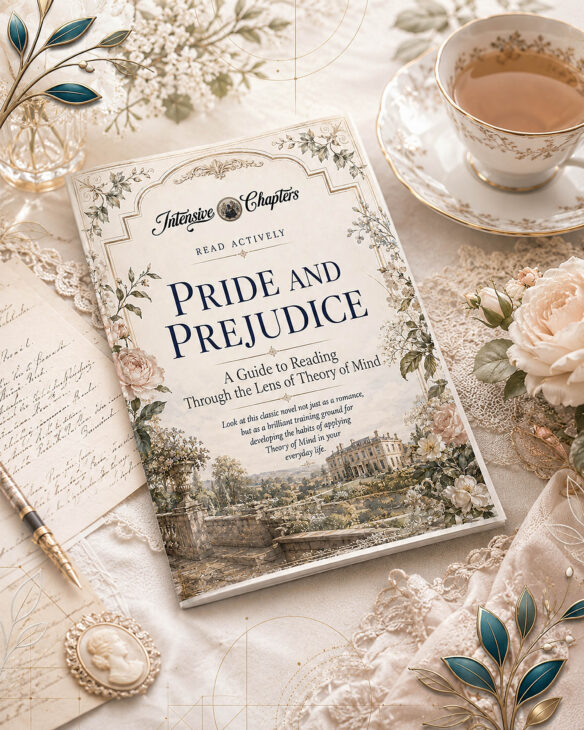
So, today I’m giving you a guide to help you read this book in a way that lets you look at the characters and their relationships through the lens of Theory of Mind. I’m not just going to tell you which key bits to watch out for or what to jot down, but also how to do it. Think of it as a great detective-slash-psychological adventure. I’ll show you how to handle this approach without feeling overwhelmed – even if you’ve never tried “active reading” before.
Ready? I certainly hope so!
Below is a PDF for you to download, but do check out the Q&A underneath first – it covers things that might pop up while you’re actively reading “Pride and Prejudice” with a Theory of Mind approach.
A quick look at some questions you might have before you dive in:
- Do I need my own copy of the book?
Yes. Either a hard copy or an e-book (if you’re happy taking notes on your phone or tablet). - Do I need to print the Guide?
Yes, if you want to scribble notes by hand. Otherwise, using the digital version is totally fine. - Do I need anything else?
Just a few things to help you mark and note things down. You’ll find some suggestions on what might come in handy inside the Guide. - Does it make sense to use the Guide if I already know the story inside out?
Absolutely. Re-reading the novel with the Guide should give you a fresh perspective on the plot and the characters, even if you know them like the back of your hand. - Do I need to worry about spoilers if I look at the Guide?
Not at all. In fact, I’d recommend skimming the whole Guide before you start the book so you know what’s what. Nothing in there should give away any major plot points. You might want to hold off on reading the “Takeaways for Everyday Life” section until you’ve finished the book, though. - I’m a man, is there any point…
Yes! Novels don’t have a gender, and “Pride and Prejudice” can make anyone laugh or feel moved. Besides, we’re focusing on psychological insights here, which are just as useful for men as they are for women.
Aga J. Mackiewicz
for Intensive Chapters
A human, not artificial intelligence, is always responsible for the substantive content and final form of all texts on this website. No text is the result of any advertising partnership. All content represents our own, sometimes subjective, opinions, and no payment has ever influenced them. Photos used in the posts are our own, while graphics are created with the help of AI tools.