

Book Review
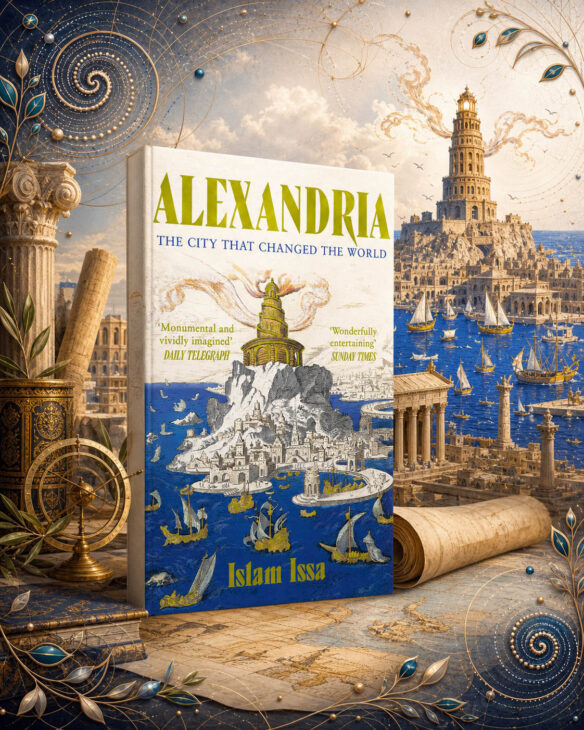
In “Alexandria. The City that Made the Modern World”, Islam Issa breaks away from the typical historian’s obsession with antiquity. Usually, many historians assume that once the Library of Alexandria burns down and Cleopatra meets her end one way or another, the city’s story is over. They tend to skip the period where this mighty metropolis faded into a sleepy fishing town, only to be reborn in the 19th century as a global trade hub once again. Issa refuses to do that. He leads the reader through the city’s streets right up to the present day, showing how modern Alexandria grapples with the weight of its own legend. It’s a struggle the city doesn’t always win – many might not fall in love with today’s Alexandria, perhaps even feeling disappointed by how far it’s strayed from the fairy-tale version of centuries past.
Islam Issa has crafted something incredibly ambitious. I doubt any reader will be equally enthralled by every single chapter of “Alexandria”, but the work as a whole is deeply impressive.
Paradoxically, Issa’s decision to cover the city from its birth to the present will be a huge selling point for some and a dealbreaker for others. Let’s be honest – Alexandria was at its most spectacular during the Ptolemaic era. I’ll openly admit I was captivated by the beginning of the book, but my interest waned later on when things were no longer quite so colourful or magical. That said, I appreciate the author’s dedication to showing Alexandria’s evolution – its glory days and its darker times – right up to the modern era. And the author’s background really matters here.
Islam Issa is a British professor of literature and history with Egyptian roots. This heritage is key. It allows him to blend Western academic rigour with a deep, almost personal understanding of the local context and language. He doesn’t look at the city like a tourist or an archaeologist, but as someone who understands its soul. Plus, his fluency in Arabic is a game-changer, but more on that in a moment. First, a quick summary of who will fall in love with this book and who might find themselves yawning.
If you’re a fan of “city biographies” – like Simon Sebag Montefiore’s “Jerusalem” – you’ll be delighted. It’s also perfect for those wanting to wrap their heads around this part of the world and its rather tangled history. By weaving together Greek, Macedonian, Jewish, Egyptian, and European influences, Issa paints a rich tapestry of Alexandria’s long existence. I should add that the language isn’t intimidating. It’s vivid and at times truly gripping, never feeling like it’s trying to prove it’s “only for academics.”
So, who might find “Alexandria” a bit of a slog? Mostly those who only want to read about the city’s ancient history and couldn’t care less about what happened next. This is a hefty tome, and the page count dedicated to social and religious shifts in later centuries is significant.
Now for my biggest gripe, which I feel quite strongly about – this is a book with absolutely no photographs or illustrations. Nothing. Zero. Zip. I found this incredibly frustrating. I understand the copyright hurdles involved in mass-market publications, but surely it would have been worth the effort to give the reader something visually stunning to match the text?
Back to the author’s approach. Critics have praised Issa for his gargantuan research, drawing from a vast range of materials – from classical Greek and Roman texts to medieval Arabic chronicles and modern government documents. This is where his Arabic comes in. It allowed him to cross-reference well-known Western sources with less common Oriental ones, uncovering documents often overlooked by Western historians due to the language barrier. British critics have called it “outstanding research,” and it’s thanks to this “titanic” effort that we don’t just stop at the proverbial burning of the Library. Issa demonstrates that Alexandria didn’t just collapse after the 7th-century Muslim conquest. It didn’t vanish, but rather underwent a slow, profound cultural transformation. When he reaches the 19th century, he uses diaries and letters from the reign of Muhammad Ali, giving us a real story about people’s lives, experiences, and emotions.
It’s not all flawless, though. Some have pointed out a slip-up where one historical figure was likely confused with another of the same name – specifically Origen of Alexandria. I know that won’t mean much to most people, but let’s call it a tiny scratch on Issa’s otherwise monumental work. There’s also the matter of his personal connection to the city. For Issa, Alexandria isn’t just a legendary site. It’s a place full of personal memories. Some argue he presents certain points as facts where other historians see ambiguity, perhaps to spice up the narrative or to “whitewash” figures he feels fondly about. Whether that’s true is probably for the experts to debate. From my perspective as an average reader, these personal ties didn’t feel like a flaw, on the contrary, they gave the final section of the book a much more intriguing character.
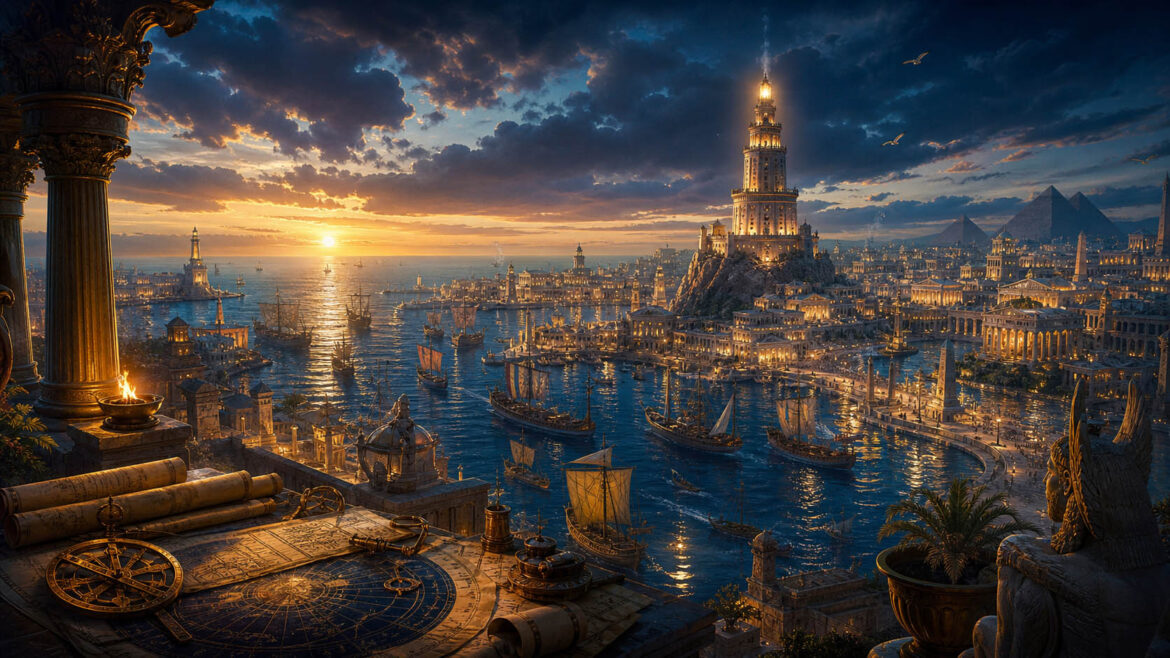
To be clear – I’m not saying everyone should devote a dozen evenings to this book. It won’t enchant everyone, and it won’t even interest everyone. But if you want to truly know this corner of the world, Islam Issa will take you on a fascinating journey through the ages, always with a view of the Pharos Lighthouse or at least the citadel that stands in its place today.
If you’re dreaming of a multisensory reading experience while exploring a monograph on Alexandria, we have the perfect soundtrack for you – “Ink of Antiquity (Reading Companion Music)”. Take a look at the very end of the post.
If you’d like to find out more about immersive and multisensory reading, take a look at this post:
Aga J. Mackiewicz
for Intensive Chapters
A human, not artificial intelligence, is always responsible for the substantive content and final form of all texts on this website. No text is the result of any advertising partnership. All content represents our own, sometimes subjective, opinions, and no payment has ever influenced them. Photos used in the posts are our own, while graphics are created with the help of AI tools.