

Book Review
It starts like this: you’re at work, experimenting with technology that “freezes” matter – a potential breakthrough enabling the centuries-long hibernation – and suddenly, something goes sideways. One second you’re dreaming of another cup of coffee, and the next, you wake up in the middle of a battle. You’re surrounded by strange creatures, smoke, and fire, with the sinking realization that you have no idea where or when you are. But you have a hunch: thousands, maybe millions of years have passed. You are likely the last human on the planet (assuming it’s even still Earth), and if you don’t get your act together fast, you’re dead.
That’s the opening of Philip J. Farmer’s The Stone God Awakens – a sci-fi classic (though I’m about to pick a bone with that “sci-fi” label).
Who will love this book? Fans of vintage sci-fi (it was first published in 1970, and you can definitely feel that era in the writing) and those who adore Farmer’s work – of whom there are many.
Returning to sci-fi classics written in the seventies is a strange adventure. It’s a bit like searching for that old thrill of watching adventure movies as a kid, only to find yourself feeling more sentimentality than anything else.
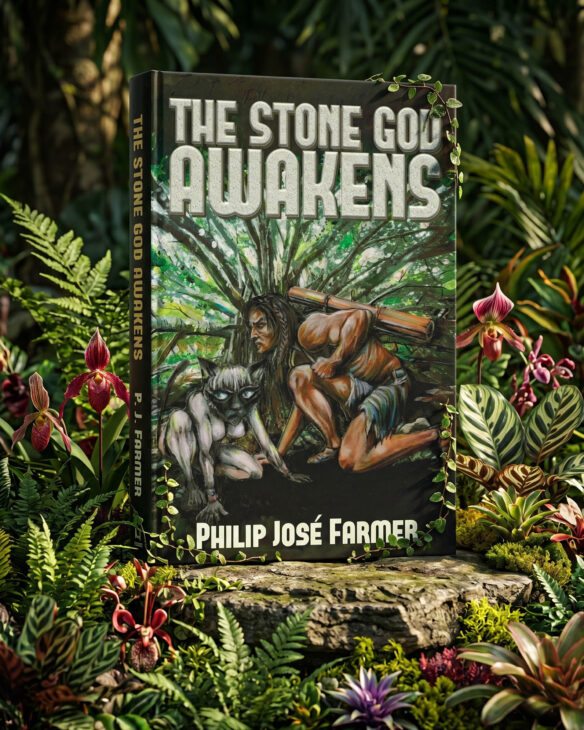
Let’s look closer at the plot, which is where my beef with the “sci-fi” tag begins. Our protagonist is named Ulysses Singing Bear, and as you’ve guessed, he has Native American roots. Does it matter? Hmmm… I didn’t really feel much weight behind it. A lab accident leaves him “frozen” as a stone statue for millions of years. When he finally wakes up (instantly gaining god-like status because the locals worshipped his statue and believed he would come to life some day), the world is unrecognizable. One reviewer described it as a mix of the Biblical Eden and a nature documentary on steroids – and honestly, that’s surprisingly spot on.

Humanity is extinct, but evolution never stands still. Instead, we get intelligent animals: talking cats, warrior raccoons, and clever, somewhat two-faced bat-creatures. Farmer shows us what Earth might look like if it got a second chance at existence without us. Now, for some, this next part is a perk; for others, it’s a total snooze-fest: the author packed the book with so many descriptions of plants and creatures that the audiobook really should be narrated by a professional nature doc voice. While this “greenery” makes the setting feel unique, it quickly becomes clear that although the characters don’t look human, their behaviours, intentions, bickering, and wars feel very much so.
But! Crucially, this isn’t a difficult, jargon-heavy read. It’s full of world-building and even more action. If you love classic adventure cinema, you’ll likely recognize the same vibe, the same tropes, and the same narrative beats.
Now, about that “sci-fi” argument. For a science fiction novel, there isn’t much technology here – zero space travel and very few scientific references, though a fascinating “green tech” theme pops up in the second half. I’d rather call it post-apocalyptic, just pushed way, way into the future. It’s not about humanity trying to survive as a group of lucky (or cursed) survivors; it’s about a single man trying not to die from page one, while simultaneously leaning into the myth of his own divinity – a status handed to him by chance that might be his only shot at staying alive.
A fair warning: if you find the 1970s writing style a bit too simplistic or old-fashioned, or if you feel “suffocated” by the sheer volume of flora and fauna, you might struggle to enjoy The Stone God Awakens.
Side note – Philip J. Farmer’s obsession with nature and evolution wasn’t accidental. In many of his books, he blended biology, ecology, and anthropology with religion. He was particularly fascinated by how biology shapes culture. He also loved building monumental, bizarre worlds – here we have a colossal tree; in another book – an endless river. These environments are always the starting point for his plots and act as characters themselves. In this book, that massive tree is even considered sentient.
I gave it a solid 6/10. As a return to something I read years ago (I won’t even admit how many), it was a pleasant experience, but neither the concept nor the execution totally blew me away.
Aga J. Mackiewicz
for Intensive Chapters
A human, not artificial intelligence, is always responsible for the substantive content and final form of all texts on this website. No text is the result of any advertising partnership. All content represents our own, sometimes subjective, opinions, and no payment has ever influenced them. Photos used in the posts are our own, while graphics are created with the help of AI tools.