


Book Review
First, a little trivia connected with the Polish edition that I’ve read, but probably a meaningful one. The Polish title of this novel is “To jeszcze nie koniec” (It’s Not Over Yet), which suggests that a story only appears to be finished, but will either continue or come back to haunt one of the characters. I’ll tell you right now – that checks out with the plot. However, if you look at the copyright page, the original title is “The One That Got Away”. In terms of what it hints at, it might suggest even more than the Polish one. Does it? Is it “the woman who escaped,” or perhaps “the guy who got away with it”? Naturally, I won’t tell you.
This is Egan Hughes’ debut. It’s been met with mixed reviews, ranging from pure delight to disappointment. For me, it’s a fifty-fifty split. Details in a moment.
If I had to summarize the plot in a single sentence, it would be something like this: The dark aspects of human relationships involving pathological control and subsequent trauma, which carries a massive potential for ending in revenge.
This life-voyage had no right to end well. The question is: is this inevitable end actually as good a read as the publisher suggests? Hmm…
The starting point of the story is the moment when the main character, Mia, is trying to rebuild her life. She has left her morbidly controlling and toxic husband and feels she’s finally reached the stage where things are getting better. And that’s exactly when the police knock on her door to tell her that her ex-husband has been found dead. Someone shot him on his boat. Who? And who is the first person to be suspected? Those closest to him. Which means Mia won’t be getting much sleep. Not that she would anyway – she has secrets that could be dangerous in this situation.
However, the main theme of the novel isn’t actually the crime itself. It’s an analysis of the mechanisms of psychological and emotional abuse and excessive control. Hughes describes a relationship that seems like a fairy tale, a “happily ever after,” but it quickly turns out to be more like a story written by the Brothers Grimm on a very bad day. And let me tell you straight away: while I didn’t rate the crime plot very highly, the psychological aspect was much better. I even wonder if the author – instead of stubbornly trying to force a thriller that wasn’t quite perfect – could have created an atmospheric, stifling contemporary novel with a crime subplot in the background. She was actually quite good at describing marital relations in those almost claustrophobic circumstances. But that’s just my opinion; feel free to disagree.

Sudden, surprising plot twists are a hallmark of thrillers. At least in theory, because that’s not really what happens here. There are moments that spark more interest or a slight surprise, but did anything trigger major emotions in me? I’m afraid not. None of them surprised me to the point of gasping, “Wow, look what happened, I didn’t see that coming.” Many people in their reviews claim the ending is satisfying, explains everything, and ties all the threads together. Yes, I agree, but unfortunately, as I closed the book, I felt a slight sense of relief that it was over – a sensible ending, I admit, but I didn’t regret for a second that there wasn’t one more chapter.
The ending was a perfect example of the author’s style – she doesn’t craft a fluid, gripping story designed to evoke the specific emotions of a thriller. From the very first pages, I described her writing as “jittery,” and the ending was no different. And it’s not about writing about a dark atmosphere of danger, but about creating one in the reader’s head.
One heads-up, as many people don’t like this – the author uses time jumps between different years. However, they are clearly marked in the text and kept within separate chapters, so you don’t feel lost or confused about who or when you’re reading about. The narrator also changes between these parts, which adds some intriguing elements to the story.
I gave it a 6/10. As a thriller, it would have been a 4/10, but in my mind, the psychological layer saved the score.
By now, you know I think this should have been a dark psychological drama with a crime element, but while reading, my main problem was something else. I just couldn’t reconcile the fact that this is labeled as a “psychological thriller.” It just didn’t add up for me. If someone asked me, I’d say it’s a crime novel with a strong psychological background, but a thriller? No.
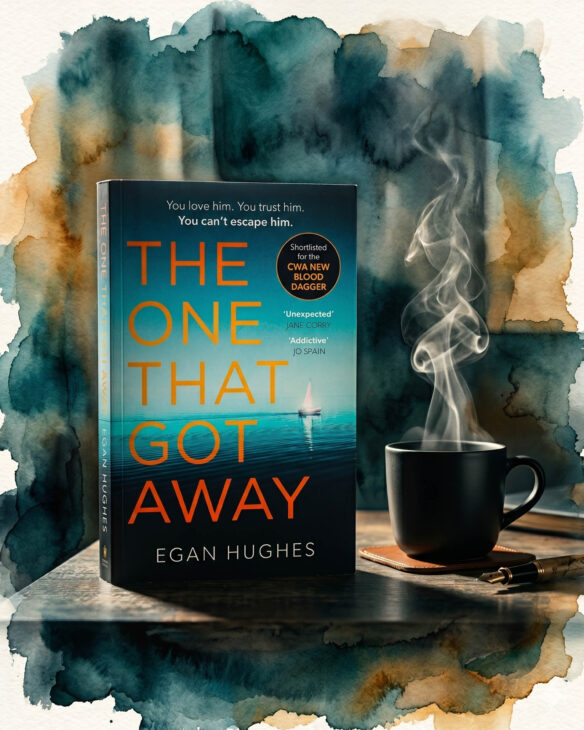
I was so at odds with the “Thriller” label on the cover versus my “Crime Novel” vibes that I actually googled the main differences between the two genres, and here is what I found:
- The main difference comes down to when the crime occurs and what the author focuses the reader’s attention on. In a crime novel, we look for the answer to “who did it?”. In a thriller, it’s about “what happens next?” and “who will survive?”. Following this logic, it is a CRIME NOVEL.
- A crime novel often starts with the discovery of a body. A thriller starts with situations and events that create a sense of escalating danger, and the murder happens later – or not at all, because it can be prevented. Following this logic, it is a CRIME NOVEL.
- The next difference is a description I really like. A crime novel has an “intellectual” pace – deduction, evidence gathering, interrogations. A thriller has a “sprinting” pace – a race against time, high action, twists, and rising anxiety. In my opinion, this novel is still a CRIME NOVEL!
- Finally, the protagonist. In crime novels, it’s often a cop or a detective who uncovers what happened with a certain level of professional distance. In a thriller, the hero is an ordinary person caught up in something dangerous that affects them personally. And if you think I’m finally going to say “thriller,” you’re wrong – because the author constructed her protagonist in a way that she basically conducts an investigation, asking questions and poking around to find out who and why did it… CRIME NOVEL!
I would stick to my guns and call this a crime novel with a psychological background. But many will argue with me because we have a protagonist with a very subjective point of view, who could even be called an “unreliable narrator,” and an emotionally unstable one at that. They would argue it’s more of a story with a stifling atmosphere and elements of manipulation than a police procedural. And if it were a crime novel, there would have to be more explanation of motives – but it’s worth noting that the police are present and active, while Mia plays the role of the lead “detective.”
Read it, judge for yourself, and let me know: do you put this story in the “thriller” box, the “crime” box, or the “heaven knows what it is, but it’s pretty good/pretty bad” box?
Aga J. Mackiewicz
for Intensive Chapters
A human, not artificial intelligence, is always responsible for the substantive content and final form of all texts on this website. No text is the result of any advertising partnership. All content represents our own, sometimes subjective, opinions, and no payment has ever influenced them. Photos used in the posts are our own, while graphics are created with the help of AI tools.