

Book Review
Let me start with an assumption: every book is the “right” book for someone. More specifically, it’s the right book for someone at a particular moment. Sometimes I’m in the mood for a political thriller; other times for a romantic comedy. And then there are days when I want something that looks like someone threw the apocalypse, a game show, an RPG, gallons of blood, and low-brow humour into a single pot. In other words – welcome to the world of “Dungeon Crawler Carl”.
Back to the title – why do I think of Matthew Dinniman’s novel as a “B-movie” book? Not because I think it’s inferior to others. That’s for everyone to judge for themselves. By “B-class,” I mean a certain “artistic” direction. It’s a style that has existed in cinema for a long time and has its own devoted followers. These are productions that are kitschy, over-the-top, and sometimes clearly “cheap,” yet so unique and bold in their concept that they achieve cult status. Movies like “Killer Klowns from Outer Space”, “The Texas Chain Saw Massacre”, or “Under Paris” don’t win people over with the subtlety of their storytelling. They win with their premise, their excess, their atmosphere, and that specific feeling that someone went a few steps too far, decided it still wasn’t enough, and then took two more giant leaps toward pure camp.
There are books that make you feel smarter after reading them, and then there are those that leave you wondering, “What on earth just happened?” – “Dungeon Crawler Carl “definitely falls into the latter category.
“Dungeon Crawler Carl” is built from that exact same energy. There is violence, absurdity, the grotesque, and exaggeration. There’s also an atmosphere that, at times, reminds me more of “Evil Dead” than classic science fiction. In my mind, Carl quickly took on the face of Bruce Campbell, and honestly, it was hard to shake that image. That’s not a criticism, by the way. It sets the tone for the book perfectly. If you go into it expecting literary elegance, intellectual entertainment, or a balanced tale about the human condition in a modern technological world, you’ll likely bounce off it painfully and be disappointed beyond measure. But if you accept that you’re entering a world meant to be spectacular, brutal, bizarre, and at times downright audacious, you’ll find it much easier to settle in.
The starting point, as fits a B-movie classic, is truly extraordinary. Earth becomes the stage for a live-broadcast apocalypse in the form of an intergalactic spectacle. Thanks to fish-like aliens with deeply unsettling nationalistic tendencies, everyone who was indoors at the moment of the attack is turned to ash. Only those who happened to be outdoors survive. They are then invited to the Dungeon – a giant, deadly reality show loosely based on “Dungeons & Dragons” rules. So, we have monsters, bosses, loot, levels, floor gates, and a fight to the very end.
One of the survivors is Carl. Along with him, Princess Donut – his ex-girlfriend’s Persian cat – ends up in the Dungeon. That pairing alone says a lot about the tone of the story. Naturally, as the cat gains experience levels, she becomes a talking entity and an equal player, with very clearly defined views on the situation, which she expresses without restraint. The Dungeon has eighteen levels. Each will collapse after a set amount of time. Before that happens, the participants must find a way down. Unless they die first. The scale of death here is so immense that it quickly stops feeling realistic and starts acting as just another element of this macabre show. This is important because “Dungeon Crawler Carl” establishes violence not as something intimate or moving, but as part of a monstrously oversized spectacle.
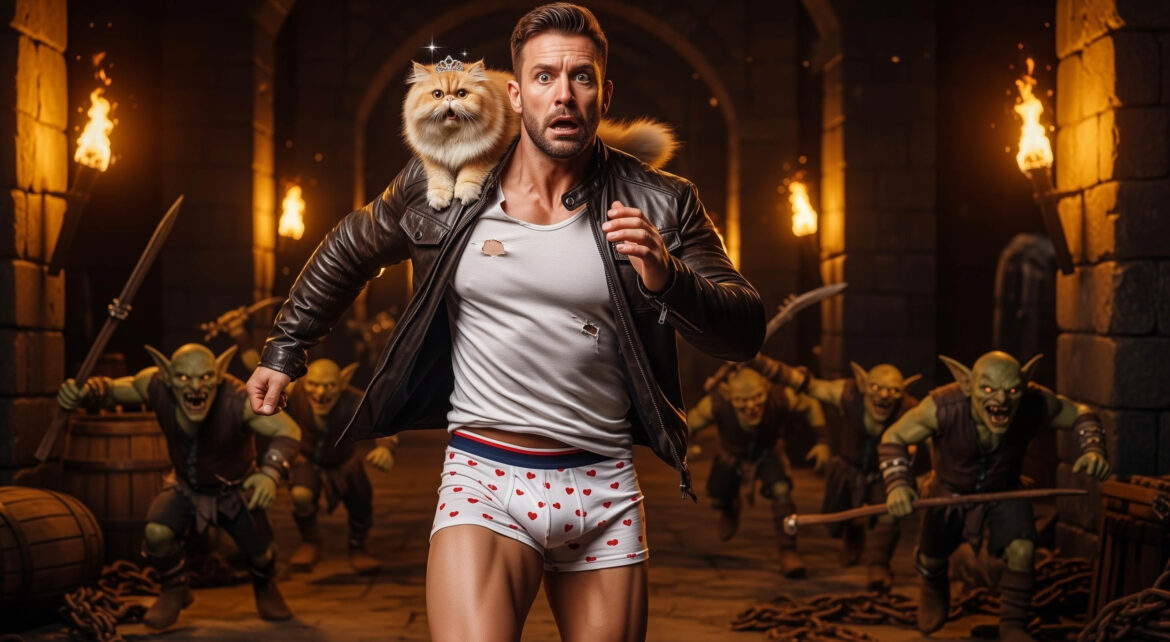
The whole thing is presented in a LitRPG format – a genre I really enjoy. And here lies my main issue with the book – formally, everything checks out, but in practice, I feel like the novel merely passed LitRPG in the hallway rather than actually moving in with it. The beginning seemed brilliant to me. After entering the Dungeon, Carl and Donut fight their first few battles and then meet a mentor. This stage works like a well-designed tutorial. It’s comprehensive, logical, consistent, and clearly explains the rules of the world. I love that approach – no unnecessary ambiguity, no pretending there’s a mystery where clarity is needed. And you have to give it to the author: he sticks to those rules later on.
The problem is that the LitRPG aspect itself is treated quite superficially. There are almost no stats, which for me are one of the foundations of the genre. My beloved “Way of the Shaman” series practically wallowed in tables, parameters, detailed changes, and precisely showing what a specific fight or item did to the hero. Here, it’s more like: level up, stamina boost, something improved. And that’s it. For some, this will be an advantage, as not everyone wants to wade through pages of numbers. For me, however, it wasn’t enough. If I’m diving into LitRPG, I want to feel the mechanics; I want to see the progression; I want to feel that the system is actually working. Here, the system is present, but more as decoration than as a vital skeleton for the story.
The situation is similar with the items found or earned. Yes, the more important ones get elaborate descriptions. The issue is that this elaboration more often leans toward an absurd, creative backstory about the item’s origin rather than concrete details. Again, it’s sometimes funny, even very imaginative, but if you like to know exactly what a given item provides, how it affects the protagonist, and why you should care about it more than any other gadget from a mad catalogue, you might feel a sense of dissatisfaction.
And here I come to the issue that will likely divide readers the most: the humour. Absurdity in itself doesn’t bother me. On the contrary – I like absurdity, sometimes very much so. My problem is that in “Dungeon Crawler Carl”, absurdity often goes hand-in-hand with primitive and, at times, downright exhausting humour. Sure, there are crude jokes that are actually funny; as a rule, I have no problem with that. But here, it was simply too much for me. If this tone appeared every now and then, I’d probably just see it as a stylistic choice. But when the story constantly circles back to jokes at the level of public restroom graffiti, it starts to get tedious. What’s more, there are moments where the undertones border on sexism, and instead of being audaciously funny, they just end up feeling cheap.
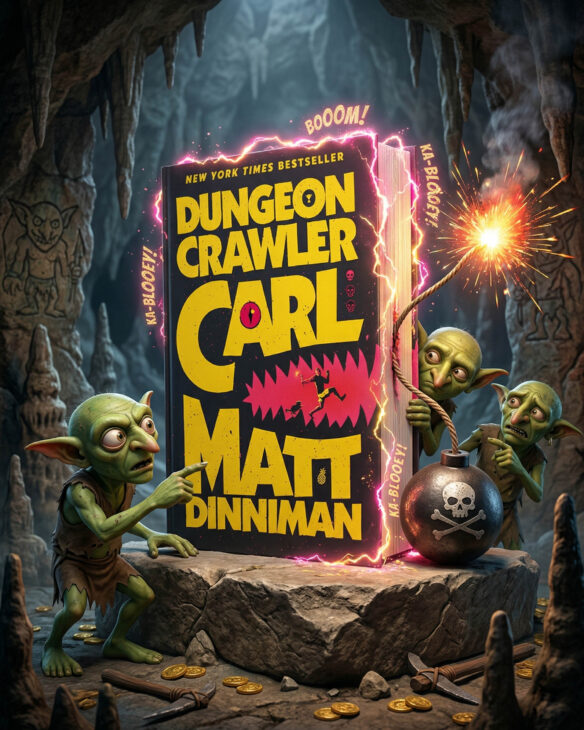
This brand of humour didn’t quite land for me. And yes, I know – judging by the reviews and opinions – I’m clearly in the minority here, as the series has been a massive success and evidently reached a very wide audience. So, take this more as a warning than a verdict. If you love that kind of over-the-top excess, there’s a good chance you’ll have a blast. If not, it’s better to know what you’re getting into beforehand.
Yet, despite all these reservations, I ultimately gave the book a 6/10. I know that might sound surprising after everything I’ve just written, but while the book often wore me down, it never quite managed to push me away. After a very promising first hundred pages, there came about two hundred and fifty more that were a real slog. This was due to the style, the humour, and above all, the feeling that the plot was standing still. I kept getting more fights – sometimes clever, sometimes spectacular – but I had the sense that, aside from just moving through the Dungeon corridors, not much was actually happening.
And then, just when I had resigned myself to getting nothing but a series of increasingly crazy boss fights and encounters until the very end, the book suddenly began to develop narratively. New threads appeared, a broader perspective emerged, and there were promises of something more than just a survivalist bloodbath. It was those last two hundred pages that pulled my rating up. Not enough for me to join the ranks of the series’ devotees, but enough that I haven’t written it off completely.
Will I pick up the second volume? Yes. But without any fanaticism. Given the hype surrounding this series, I was genuinely curious about the Polish release of book one. Perhaps that’s why the collision with reality felt so disappointing. I’ll likely buy the second novel, but this time without the rush or the feverish excitement. I’ll wait for a good sale and a moment when I feel like it’s the right time to step back into the Dungeon.
Andrzej Mackiewicz
for Intensive Chapters
A human, not artificial intelligence, is always responsible for the substantive content and final form of all texts on this website. No text is the result of any advertising partnership. All content represents our own, sometimes subjective, opinions, and no payment has ever influenced them. Photos used in the posts are our own, while graphics are created with the help of AI tools.